
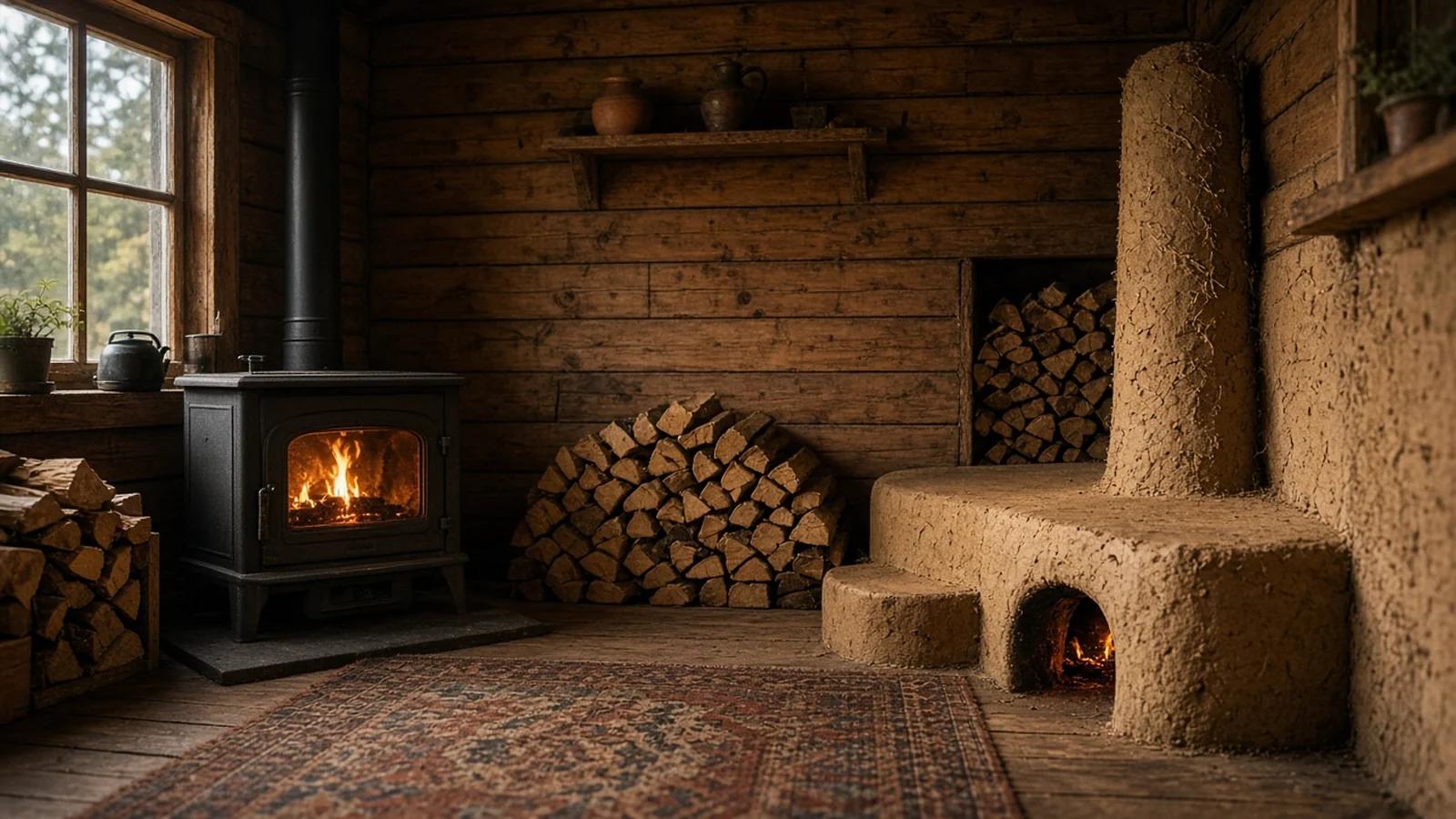
Wood heat is the backbone of off-grid heating in much of the country. It needs no electricity, the fuel can come from your own land, and it keeps working in a winter storm. The real question for most homesteaders is what to burn it in: a manufactured, certified wood stove, or a site-built rocket mass heater.
They work very differently. Here's how they compare, using the EPA's published standards and the building code's own definitions.
How each one heats
A wood stove is a metal firebox that heats the room mostly by radiating and moving warm air while the fire burns. When the fire goes out, the heat fades fairly quickly.
A rocket mass heater burns small pieces of wood very hot in an insulated "J"-shaped combustion chamber. The hot exhaust is then routed through a long duct buried in a heavy bench or floor of cob, stone or brick before it leaves the chimney. That mass soaks up the heat and releases it slowly for hours after the fire is out. Ianto Evans and Leslie Jackson's book on the subject is the standard how-to for building one.
It works on the same principle as a traditional masonry heater. The International Residential Code defines a masonry heater as a solid-fuel heater built mainly of concrete or solid masonry, weighing at least 1,100 pounds (500 kg) not counting the chimney and foundation, that routes exhaust through internal channels to store heat and release it by radiation.
Clean burning: what the EPA requires of stoves
Manufactured stoves have improved a lot. According to the EPA's Burn Wise program:
- Older uncertified stoves release 15 to 30 grams of smoke per hour.
- Under the 2020 rules (Step 2, effective May 15, 2020), new wood stoves must meet 2.0 g/h, or 2.5 g/h if tested with the optional cord wood method.
- Some newer stoves are certified in the 1 to 4 g/h range across test methods, and the EPA says a lower g/h number means a cleaner, more efficient stove.
The EPA also explains the two main designs. Non-catalytic stoves use firebox insulation, a large baffle and preheated air above the fire. Catalytic stoves pass smoke through a coated ceramic honeycomb that burns it off, and can give a long, even heat, but they need more care to keep performing. Look for the EPA certification label on the back of any stove you buy. (EPA notes that its Burn Wise site stopped being updated in October 2025, but it remains the official record of the standards.)
Rocket mass heaters are site-built, so there is no factory certification or EPA label. Advocates report very clean, efficient burns, but performance depends on the design and the builder, and there's no standard test result to compare.
Side by side
| EPA-certified wood stove | Rocket mass heater | |
|---|---|---|
| How it's made | Factory-built, tested and labeled | Site-built from plans, usually cob, brick or stone |
| Heat delivery | Strong heat while burning, fades after | Slow, steady heat from the mass for hours after the fire |
| Fuel | Split cordwood | Small-diameter sticks and split wood, fed often |
| Emissions rating | Certified g/h on the EPA label | No certification; depends on build quality |
| Weight | A few hundred pounds | Very heavy mass; floor must be checked |
| Permits and insurance | Generally the easiest path | Often difficult; depends on your jurisdiction |
| Can move it | Yes | No, it's part of the building |
The real deciding factor: code and insurance
For most people, this decides it. A listed, certified wood stove installed to the manufacturer's instructions is the familiar path for building inspectors and home insurers.
Rocket mass heaters are harder. The IRC requires masonry heaters to either meet ASTM E1602 or be listed and labeled to UL 1482. A site-built rocket heater usually has neither, and an unlisted heating appliance can be a problem for some home insurers. Code treatment of site-built thermal mass heaters has been changing, and some jurisdictions have created their own approval paths, so the honest answer is local. Before you build:
- Ask your building department whether it will permit a site-built mass heater, and under which code section.
- Ask your insurer, in writing, whether it will cover the home with one installed.
- Check the floor. A mass bench weighs far more than a stove, so confirm the structure can carry it.
Which should you choose?
- Choose a certified wood stove if you need a permit and insurance without a fight, want to heat a large or drafty space fast, or might move.
- Consider a rocket mass heater if you're building your own small, well-insulated home, your jurisdiction will permit it, you can feed small wood often, and you want stored, gentle heat from a bench you sit on.
Either way, the cheapest heat is the heat you don't lose. Insulation, air-sealing and passive solar design shrink the load before you burn anything.
What to read
Three books in our Regenerative Library cover both paths:
- Rocket Mass Heaters: Superefficient Woodstoves You Can Build by Ianto Evans and Leslie Jackson, the illustrated guide to designing and building one, with attention to safe practice.
- The Solar House: Passive Heating and Cooling by Daniel D. Chiras, on the windows, thermal mass, insulation and ventilation that cut your heating load.
- The Passive Solar House by James Kachadorian, a method for houses that heat and cool themselves with ordinary materials.
See the Heat & Cooling hub for planning steps and expert videos, including the Wisners' rocket mass heater builds.
Sources
- U.S. Environmental Protection Agency, Burn Wise. "Choosing the Right Wood-Burning Stove." epa.gov
- International Code Council. 2021 International Residential Code, definition of masonry heater and Section R1002 (Masonry Heaters). codes.iccsafe.org
- Evans, I., and Jackson, L. (2006). Rocket Mass Heaters: Superefficient Woodstoves You Can Build. Cob Cottage Company.