
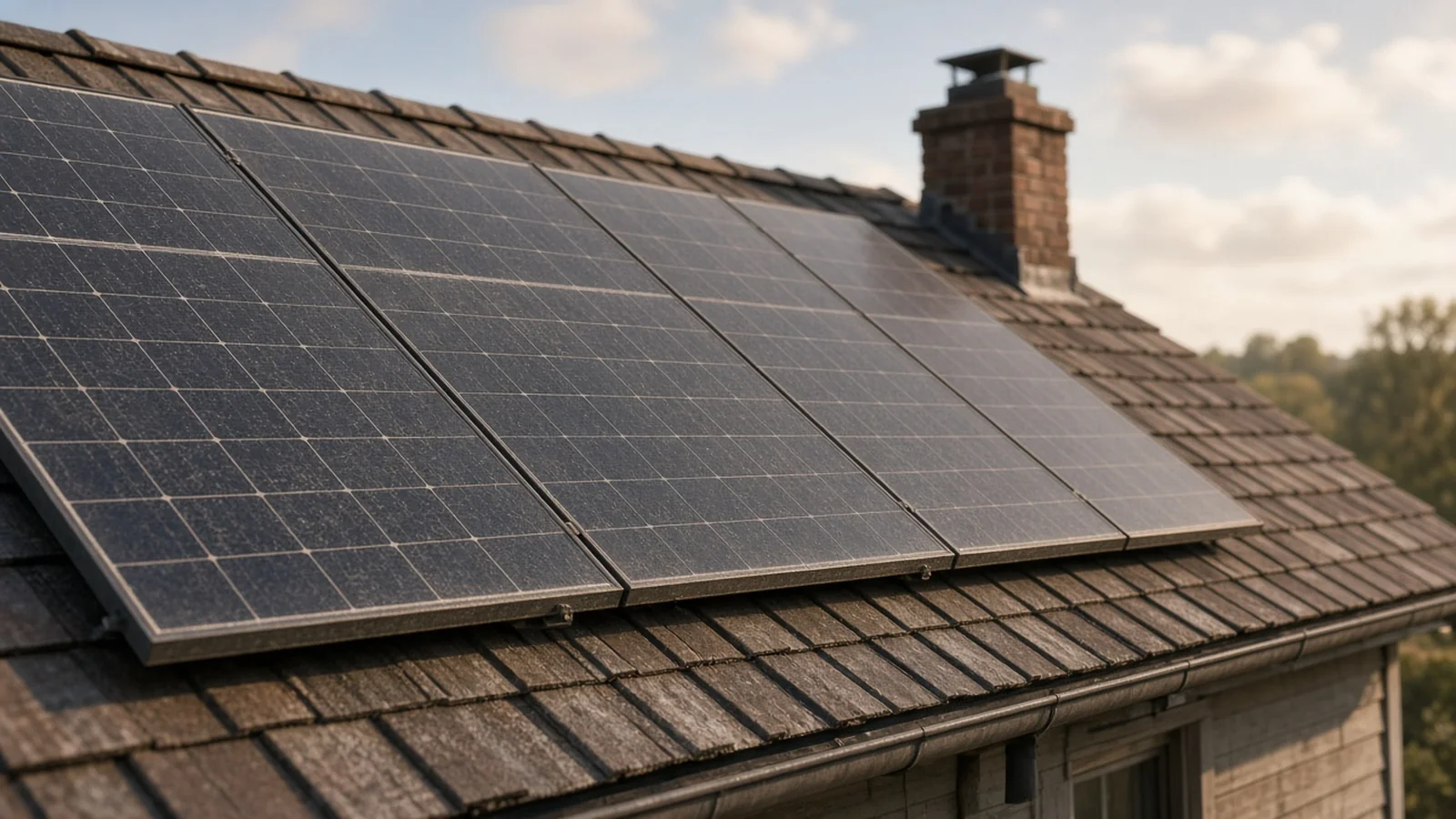
Most people picture off-grid living as a solar array on a cabin roof. The panels are actually the easy part. The hard parts come earlier: finding land you're allowed to live on, making sure there's water you can drink, and knowing where your waste goes. Get those right and the power system almost designs itself.
This guide walks through how to live off the grid in the order that saves the most money and the fewest regrets: land first, water second, power third, then waste, heat and food. Each step uses real numbers from government sources and seller pages, checked on November 17, 2026.
If you already have land and just want the solar math, go straight to our beginner's plan for living off the grid with solar power.
Short answer
- Start with the land, not the gear. Before you buy, confirm with the county that you can build and live there, that you can get water, and that the soil can take a septic system or that an alternative toilet is allowed.
- Rural land isn't cheap, but it varies a lot. USDA's 2026 survey puts average US farm real estate at $4,500 an acre and pasture at $2,000 an acre, from $735 an acre in New Mexico to $14,100 in California.
- Water decides whether a place works. EPA says an average American family uses more than 300 gallons a day at home. Off grid you'll use far less, but you still need a reliable well, spring or rain supply, and some states limit rain catchment.
- Size solar for your worst month. At 5 kWh a day, you'd need roughly 2.9 kW of panels in Denver but 6.3 kW in Montpelier, Vermont to cover December. A complete kit like the ShopSolar PRIME PLUS starts at $6,089.
- Keep a generator. The US Department of Energy's rule of thumb is to design renewables for about 80% of your energy and use fuel for the other 20%.
What to use: Before you size anything, measure what your appliances really draw. A plug-in meter like the P3 P4400 Kill A Watt on Amazon ($29.99 on the day we checked) shows watts and kilowatt-hours for anything that plugs into a standard 115-volt outlet, up to 15 amps.
What "off grid" actually means
"Off grid" isn't one thing. It's a set of utilities you replace one at a time:
| Utility | On grid | Off-grid version |
|---|---|---|
| Electricity | Power company | Solar, wind or micro-hydro, a battery bank, a backup generator |
| Water | City water | Private well, spring, surface water or rainwater, with treatment |
| Sewer | City sewer | Septic system or composting toilet, plus a plan for greywater |
| Heat and cooking | Gas line or electric | Wood, propane, passive solar, efficient heat pumps |
| Food | Grocery store | Some mix of garden, livestock, preserving and still the grocery store |
Very few people do all five at once. A common path is a property with a well and septic, solar for electricity, wood or propane for heat, and a garden that grows over the years. That's still off-grid living, and it's far more achievable than total self-sufficiency on day one.
Step 1: Decide what kind of off grid you want
Before you look at a single listing, answer four questions honestly:
- Full time or weekends? A weekend cabin can run on a small kit and hauled water. A full-time home needs year-round water, winter power and legal occupancy.
- How far from town? Remote land is cheaper, but every trip for parts, fuel, a doctor or a job costs time. Many people pick land within reach of a town they already know.
- Alone or with others? Sharing land, tools and skills cuts costs a lot. If that appeals, read our guide to finding an intentional community, ecovillage or cohousing group.
- What's the budget for the first two years? Land, a well, a septic or toilet system, a power system and a shelter all land in the same window. Write down a number for each before you fall in love with a view.
Step 2: Choose land you can legally live on
This is where most off-grid plans succeed or fail, so slow down here.
What land costs
USDA's National Agricultural Statistics Service publishes average land values every summer. The 2026 report (released July 31, 2026) puts US farm real estate, meaning land plus buildings, at $4,500 an acre, up 3.4% from 2025. Pasture averaged $2,000 an acre. Here are a few states people often look at for off-grid land:
| State | Farm real estate, 2026 ($/acre) |
|---|---|
| New Mexico | 735 |
| Wyoming | 1,030 |
| Nevada | 1,230 |
| Montana | 1,260 |
| Colorado | 2,360 |
| Oklahoma | 2,620 |
| Texas | 3,100 |
| Maine | 3,400 |
| Arkansas | 4,350 |
| Vermont | 4,490 |
| Idaho | 4,750 |
| Missouri | 5,200 |
| Tennessee | 6,500 |
| California | 14,100 |
These are statewide averages across all farmland, so a small wooded parcel near a popular town can cost far more, and a big dry parcel far from anything can cost less. Use them to set expectations, not to judge one listing.
What to check before you buy
- Zoning and building rules. Call the county planning or building department. Ask whether you can live full time on the parcel, the minimum home size, whether a permit is needed for solar, and whether they accept composting toilets. Rules vary county to county, and nobody can answer this for you online.
- Access. Is there a recorded legal road or easement to the property, and can a well-drilling rig, a concrete truck and a propane truck get there in winter?
- Water. Ask about neighboring wells and their depth, and whether your state limits wells or rain catchment (more on that below).
- Soil. Look the parcel up on USDA's free Web Soil Survey. It shows septic suitability, drainage, flooding and how good the ground is for gardens. Our step-by-step Web Soil Survey guide shows exactly what to look at.
- Sun. A south-facing clearing (in the US) matters more than any panel spec. Tall trees on the south side can cut your winter solar output badly.
- Fire and flood risk. In the West especially, check wildfire risk and what it takes to make a home defensible. Our wildfire home-hardening research summary covers what actually saves houses.
Step 3: Secure water first
You can live a long time with no power. You can't live long without water, so lock this in before you build.
How much you need
EPA's WaterSense program says the average American family uses more than 300 gallons of water a day at home, with roughly 70% of that indoors. Off-grid households typically use a small fraction of that, because every gallon has to be pumped, stored or caught. Low-flow fixtures, a composting toilet and drip irrigation make the biggest dent.
Option 1: A private well
According to the US Geological Survey, more than 43 million people, about 15% of the US population, rely on private wells for drinking water. Private wells aren't covered by the federal Safe Drinking Water Act, so you're the one responsible for the water quality.
EPA's private well guidance is simple: test your well every year for total coliform bacteria, nitrates, total dissolved solids and pH, and test again after flooding, nearby construction, or any repair to the well.
To run a well pump off solar, see our guide on how to pick and size a solar well pump kit.
Option 2: Rainwater
Rain adds up fast. USGS works out that 1 inch of rain on a 40 × 70 foot roof (2,800 square feet) gives about 1,743 gallons, which is about 0.62 gallons per square foot per inch. A 1,000-square-foot roof catches about 620 gallons from a single inch of rain.
Check your state's rules first, though. In Colorado, for example, the Division of Water Resources allows most homes to collect rooftop rain in up to two rain barrels with a combined 110 gallons, for outdoor use only, unless the property has (or qualifies for) a residential well, in which case a permit can allow more. Other states encourage catchment, and some offer tax breaks.
Use our rainwater storage calculator to match your roof and rainfall to a tank size, and read what 577 Arizona samples showed about rain barrel water quality before you use it on food crops.
Option 3: Springs, ponds and creeks
Surface water usually needs both a legal right to use it and serious treatment before drinking. It's great for livestock, gardens and fire protection. Our guide to solar water pumps for tanks, ponds and irrigation covers moving it where you need it.
Step 4: Plan the power
Now the panels. The order here matters too: measure, cut, then size.
Measure what you use
The US Energy Information Administration reports that the average US residential customer bought 10,791 kWh of electricity in 2022, about 899 kWh a month, or roughly 30 kWh a day. Powering that much from off-grid solar is possible but expensive.
Start by measuring. A plug-in meter like the Kill A Watt P4400 shows what a fridge, freezer, pump or laptop really uses over a day or a week. Hard-wired loads, like a well pump or a central air handler, need the nameplate wattage or an electrician's clamp meter instead.
Cut the big loads
The biggest electric loads in most homes are heating, cooling, water heating, cooking and clothes drying. Off-grid homes usually move these to other fuels or to the sun: wood or propane heat, a propane or solar water heater, a propane range, and a clothesline. That one change is how many off-grid homes get down to 4 to 6 kWh a day, and it shrinks every part of the power system.
Size for winter
Panels make far less in winter, so size the array for your darkest month. A quick formula is:
array kW = daily kWh ÷ (peak sun hours × 0.75)
The 0.75 allows for wiring, heat, dirt and battery losses. Here's what a home using 5 kWh a day would need to cover December, using NASA POWER's 2001–2025 average sun hours for flat ground in each state capital (the same data in our off-grid solar calculator):
| Location | Year-average sun hours | December sun hours | Panels for 5 kWh/day in December |
|---|---|---|---|
| Phoenix, AZ | 5.85 | 3.08 | 2.2 kW |
| Santa Fe, NM | 5.43 | 2.89 | 2.3 kW |
| Austin, TX | 4.81 | 2.74 | 2.4 kW |
| Denver, CO | 4.85 | 2.29 | 2.9 kW |
| Little Rock, AR | 4.44 | 2.28 | 2.9 kW |
| Nashville, TN | 4.23 | 1.92 | 3.5 kW |
| Boise, ID | 4.56 | 1.39 | 4.8 kW |
| Augusta, ME | 3.70 | 1.28 | 5.2 kW |
| Helena, MT | 4.01 | 1.17 | 5.7 kW |
| Salem, OR | 3.88 | 1.09 | 6.1 kW |
| Montpelier, VT | 3.47 | 1.06 | 6.3 kW |
Flat-ground numbers lean conservative, because panels tilted toward the winter sun collect more. Still, the pattern is clear: in the cloudy north, either the array gets big, or the generator runs more in December.
Batteries and backup
DOE's homeowner guide says battery banks for stand-alone systems are typically sized for one to three days of operation, and that a general rule is to design the renewable system for 80% of your energy and cover the other 20% with fuel. For 5 kWh a day, two days of storage means about 10 kWh of usable battery.
That's close to what complete kits ship with. The ShopSolar PRIME PLUS, a 4.4 kW kit with an EG4 6000XP inverter, started at $6,089 with a 10.2 kWh battery on November 17, 2026 (before racking; roof and ground-mount versions cost more). For a full walk-through of loads, panels, batteries and inverters, see the solar power plan, and compare complete systems in off-grid solar kits compared. For a small cabin, start with off-grid cabin solar: kits and sizing.
Our battery bank calculator does the storage math for your own load, and our LiFePO4 battery guide and inverter guide cover the two parts people most often get wrong.
Step 5: Deal with waste
Where your waste goes is a legal question as much as a technical one, so ask the county early.
- Septic system. EPA describes a typical septic system as a septic tank plus a drainfield. The tank separates solids, grease and scum, and the liquid then flows into the drainfield, where the soil filters out bacteria, viruses and nutrients. That's why soil and site testing come before the permit. If the soil drains too fast, too slowly, or sits on a high water table, you may need a more expensive engineered system.
- Composting toilet. These skip the black water entirely and can shrink or replace a septic system where the county allows it. Our composting toilet buyer's guide covers how they work and what to ask before you buy.
- Greywater. Shower, sink and laundry water can often be reused for irrigation, but the rules differ by state. Colorado, for example, treats greywater use as part of its water-rights system.
Step 6: Heat, food and shelter
Once land, water and power are sorted, the rest becomes a long-term project rather than a hurdle:
- Heat. Wood is the classic off-grid fuel. See wood stove vs rocket mass heater. In milder climates, see how cold-climate heat pumps performed in DOE's field test, keeping in mind that a heat pump adds a big electric load.
- Shelter. Many people start in an RV, cabin or small home and build bigger later. If you're drawn to natural building, start with what the IRC strawbale appendix actually requires.
- Food. Start small: a few raised beds, cover crops, and a pantry. Our cover crops research summary and beginner's guide to safe home canning are good places to begin.
A realistic first-year order
- Decide full time or part time, and set a budget for land, water, waste, power and shelter.
- Shortlist land. Check zoning, access, soil, sun, water and fire risk for each parcel before making an offer.
- Buy the land. Get the well drilled, or set up rain catchment, and test the water.
- Get the septic permit, or county approval for a composting toilet.
- Measure your loads, cut the big ones, and size solar for December.
- Install power and a backup generator, then the shelter.
- Add heat, the garden and food storage over the following seasons.
You can live on site in an RV or a small cabin with a portable power station during steps 3 to 6, which lets you learn the land before you commit to where the house goes.
Mistakes to avoid
- Buying land before calling the county. "No restrictions" in a listing isn't the same as a county confirming you can live there full time.
- Assuming you'll find water. Ask about neighboring wells, and budget for a well that's deeper than you hope.
- Sizing solar on annual averages. Annual sun hours make the system look small. December is what leaves you in the dark.
- Running everything on electricity. Electric heat, water heating and clothes drying can multiply the size of your solar system.
- Skipping the water test. A private well is your responsibility. Test it every year.
- Going it alone. Neighbors, local installers, extension offices and communities save more money than any gadget.
Sources
- USDA National Agricultural Statistics Service: Land Values 2026 Summary, released July 31, 2026: US farm real estate $4,500/acre, cropland $6,020/acre, pasture $2,000/acre, and state values. Checked November 17, 2026.
- US EPA WaterSense: How We Use Water: more than 300 gallons a day per family, roughly 70% indoors. Checked November 17, 2026.
- US EPA: Protect Your Home's Water: test private wells annually for total coliform bacteria, nitrates, total dissolved solids and pH. Checked November 17, 2026.
- US Geological Survey: Domestic (Private) Supply Wells: more than 43 million people, about 15% of the US population, rely on private wells. Checked November 17, 2026.
- US Geological Survey Water Science School: Rain and Precipitation: 1 inch of rain on a 40 × 70 foot roof is about 1,743 gallons. Checked November 17, 2026.
- Colorado Division of Water Resources: Rainwater, Storm Water & Graywater: two rain barrels, 110 gallons combined, outdoor use; larger permits for well-qualified properties. Checked November 17, 2026.
- US EPA: How Your Septic System Works: septic tank plus drainfield, with soil treating the effluent. Checked November 17, 2026.
- US Energy Information Administration: How much electricity does an American home use?: 10,791 kWh a year (about 899 kWh a month) in 2022. Checked November 17, 2026.
- US Department of Energy, Office of Energy Efficiency and Renewable Energy: Clean Energy Choices: Tips on Buying and Using Renewable Energy at Home: the 80/20 design rule and one-to-three-day battery banks. Checked November 17, 2026.
- NASA POWER all-sky surface irradiance, 2001–2025 climatology for state capitals, as used in our off-grid solar calculator (pulled November 3, 2026).
- ShopSolar: PRIME PLUS 4.4 kW Complete Solar Kit: $6,089 with 10.2 kWh battery, own racking. Checked November 17, 2026.
- P3 International Kill A Watt P4400 product listing on Amazon: $29.99, 115 V AC, 15 A max, 1,875 VA max. Checked November 17, 2026.