
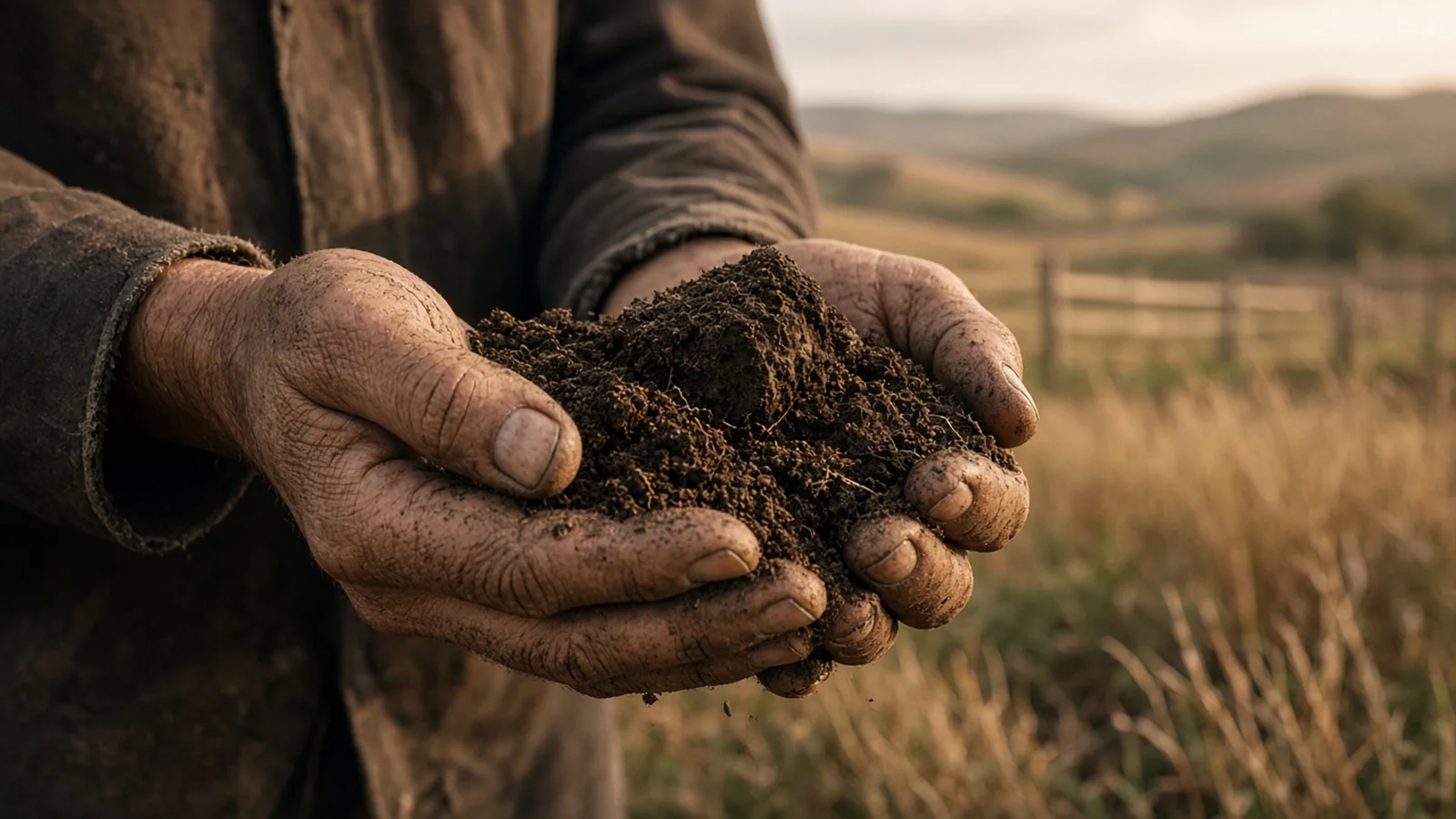
Cover crops have a great reputation. Sow rye, clover or vetch in the off-season, and you're promised better soil, fewer weeds, free nitrogen and bigger harvests. Regenerative growers treat them almost as a rule.
But does that hold up for vegetables, the crops most homesteaders actually grow? A peer-reviewed review published in 2026 in the European Journal of Agronomy pulled together 79 field studies on cover crops in vegetable growing to find out. The short answer: cover crops helped more often than they hurt, but they hurt often enough that you shouldn't roll them out across your whole garden on faith.
Here's what the researchers found, what they couldn't answer, and how to use it on your own beds.
The study in one paragraph
Researchers at Cranfield University and the University of Nottingham in the UK (Matthew Smee, Nicholas Girkin, Robert Simmons and Natalia Falagán) searched the Scopus database for peer-reviewed studies on cover crops and living mulches in vegetable and horticultural production. The search started with 161 articles. After screening, 79 peer-reviewed articles met their rules: real field data, on cover crops or living mulches, in vegetable systems, in Europe. The studies span roughly 25 years of research, since the earliest matching paper appeared in 1997. Tomato, cabbage, pepper, courgette (zucchini), lettuce and baby leaf, onion, carrot and cauliflower were the most studied crops.
Study type: a "Rapid Evidence Assessment", which is a streamlined systematic review that follows the PRISMA reporting standard. It is peer-reviewed and open access (CC BY 4.0). It is not a meta-analysis: the authors counted how many studies reported each outcome rather than pooling the data into one average effect size. The literature search was finished in August 2023, so newer field trials aren't included.
What they found
The review sorted every reported outcome into "better" or "worse" and counted how many studies (or instances) reported each one, and across what share of the crops studied.
| Outcome | Reported as improved | Reported as worse |
|---|---|---|
| Yield and quality | 49 studies, more than 80% of crops | 31 instances, 60% of crops |
| Soil health indicators | 37 studies, 60% of crops | none reported |
| Synthetic inputs (fertilizer, herbicide, pesticide) | Reduced in 29 studies, 48% of crops | none reported |
| Weeds | Fewer in 24 studies, 60% of crops | More in 8 studies, 20% of crops |
| Nitrogen available to the crop | More in 16 studies, 44% of crops | Less in 7 instances, 20% of crops |
| Soil carbon storage | Increased in 10 instances, 28% of crops | none reported |
| Pests and disease | Reduced in 10 instances, 32% of crops | none reported |
A few examples from the studies the review cites:
- Courgette and lettuce: in one study (Lenzi et al., 2015), courgette yields rose from 7.9 to 9.2 tonnes per hectare and lettuce from 19.9 to 23.7 tonnes per hectare after a cover crop was introduced. In garden terms, that's roughly 0.79 to 0.92 kg per square meter for courgette and 1.99 to 2.37 kg per square meter for lettuce.
- Peppers after vetch: Radicetti et al. (2013) saw pepper yield jump from 15.3 tonnes per hectare on bare soil to 45.6 tonnes per hectare when peppers followed a pure stand of common vetch.
- Soil: one study found soil bulk density 2.5% lower (meaning slightly less compacted soil) in eggplant grown with a white clover and perennial ryegrass cover. Another saw a 1.4-fold increase in soil organic matter under a rye cover crop.
Those are the headline wins. The downside is just as real.
The catch: the same cover crop can help one crop and hurt the next
Yield and quality losses showed up in 31 instances. Cabbage, courgette, cauliflower and peppers were the crops most often hit, and in some cases the losses reached 100%, meaning a failed crop.
The most striking finding is how much results flipped depending on the crop and the place:
- Same system, opposite results. Di Bene et al. (2022) found lettuce yields rose 10% under a cover crop system while courgette yields fell 55% under the same management.
- Living mulch vs. crop type. White clover grown as a living mulch (left growing alongside the vegetables) reduced pepper yields, while tomato yields stayed largely the same.
- Same crop, different country. Cauliflower under the same cover crop management had fewer aphids in Denmark but more in Italy. Nitrogen uptake in cauliflower fell in Denmark but rose in Italy.
- Nitrogen can go either way. Hairy vetch and white clover release nitrogen quickly, which helped some following crops. Crimson clover and sweet clover release it more slowly. Where nitrogen dropped, the causes were nitrogen being tied up as a turned-in cover crop broke down, or a living cover crop competing with the vegetables. Mixes such as vetch with barley were reported to balance nitrogen release and reduce leaching.
How the cover crop was ended mattered too. The two most common methods in the studies were plowing it in and roller-crimping (flattening it into a mulch). Plowing generally gave bigger yields in the next crop, especially after legumes like vetch and clover, because the nitrogen became available faster and the cover stopped competing. Roller-crimping gave lower immediate yields, for example in cabbage, but may build soil organic matter over time.
The authors' own conclusion is blunt: cover cropping "should not be viewed as inherently regenerative, but as a practice whose outcomes depend on how and where it is implemented."
What's still unproven
This review is a useful reality check, but it has clear limits:
- It's European, and mostly Italian. Every study was in Europe, and 34 of the 79 came from Italy. The authors flag that this tilts the evidence toward Italian crops like tomato. US climates from the desert Southwest to the Upper Midwest may behave differently.
- It counts results; it doesn't weigh them. A small trial and a large one each count as one study. There's no pooled average yield effect you can plug into a plan.
- Many studies left out the details you'd need. The authors note that many papers didn't say which cover crop species were used, whether it was a single species or a mix, whether it was grown before the vegetables or alongside them, or how it was ended. That's why they can't say which cover crop works best for which vegetable.
- These are farm and research plots, not backyards. Results in tonnes per hectare come from field trials. A raised bed with heavy compost may respond differently.
- Big gaps remain. Only two studies looked at pollinators and beneficial insects, with inconclusive results. Only three looked at why growers do or don't adopt cover crops. In one of those (Canali et al., 2015), 75% of respondents accepted cover crop practices, but 25% considered them ineffective or too risky. Few studies measured nutrition in the harvested food, so claims that cover crops make vegetables "more nutritious" are not settled.
- Costs weren't measured. The authors call for cost-benefit studies; they don't know when the benefits outweigh the seed, labor and lost growing time.
What to do with this on your homestead
The review's practical advice is to test, monitor and adjust on your own ground rather than follow a blanket rule. Here's how that translates to a homestead garden:
- Trial one bed first. Sow a cover crop in one bed and leave a similar bed bare (or mulched the way you usually do). Grow the same vegetable in both next season and weigh the harvest. That's the "iterative testing" the authors recommend, at garden scale.
- Match the cover crop to what follows. Some of the clearest wins came from legumes: peppers grown after vetch, and a Danish study (Thorup-Kristensen, 2006) where plowing in legume and grass covers improved nitrogen supply, rooting depth and yield in the cabbage, carrot, onion and lettuce that followed. But cabbage, cauliflower, courgette and peppers were also the crops that most often lost yield in other studies, so trial before you commit a whole bed of them.
- Be careful with living mulches. Clover grown alongside vegetables can compete with them, as the pepper results show. If you try it, start with a crop that held up, like tomato, and watch closely.
- Think about how you'll end it. Turning in a legume cover gave faster nitrogen and better short-term yields in the studies. Crimping or cutting and leaving it as mulch is slower but may build soil organic matter. Pick based on whether this season's harvest or long-term soil building matters more for that bed.
- Watch weeds and nitrogen. If weeds get worse or the next crop looks pale and slow, that matches the failure patterns in the review. Adjust the species, the timing or how you end it next time.
Before you choose a site, it's worth checking what soil you're working with. Our guide to checking a property's soil before you buy walks through the free USDA Web Soil Survey and NRCS's soil health practices, including keeping the ground covered. For the bigger picture of how food and soil fit together on a homestead, see the Food and Land & Soil hubs, or start the homestead planner.
What to use or try
The review keeps saying the same thing: choose species and timing for your conditions, then test. The best practical companion we know for that is a US handbook:
- Managing Cover Crops Profitably, 3rd Edition (SARE Outreach, edited by Andy Clark, 244 pages). It covers how and why cover crops work and has profiles of the common species, including cereal rye, oats, buckwheat, brassicas and mustards, crimson clover, hairy vetch, field peas and white clover. It also has chapters on crop rotation and managing pests with cover crops, and an appendix on testing cover crops on your own farm. USDA's SARE program also offers it as a free PDF on its website if you'd rather read it on screen.
For growing methods once your soil is in shape, The New Organic Grower by Eliot Coleman and The Market Gardener by Jean-Martin Fortier are in our Regenerative Library, alongside soil books like Teaming with Microbes.
Sources
- Smee, M., Girkin, N.T., Simmons, R., and Falagán, N. (2026). "Uncovering the potential of cover cropping for regenerative horticulture." European Journal of Agronomy, 180, 128243. Peer-reviewed, open access (CC BY 4.0). https://doi.org/10.1016/j.eja.2026.128243 (full text also in the Cranfield University repository).
- SARE Outreach (2007). Managing Cover Crops Profitably, 3rd Edition, edited by Andy Clark. Sustainable Agriculture Research and Education. https://www.sare.org/resources/managing-cover-crops-profitably-3rd-edition/