
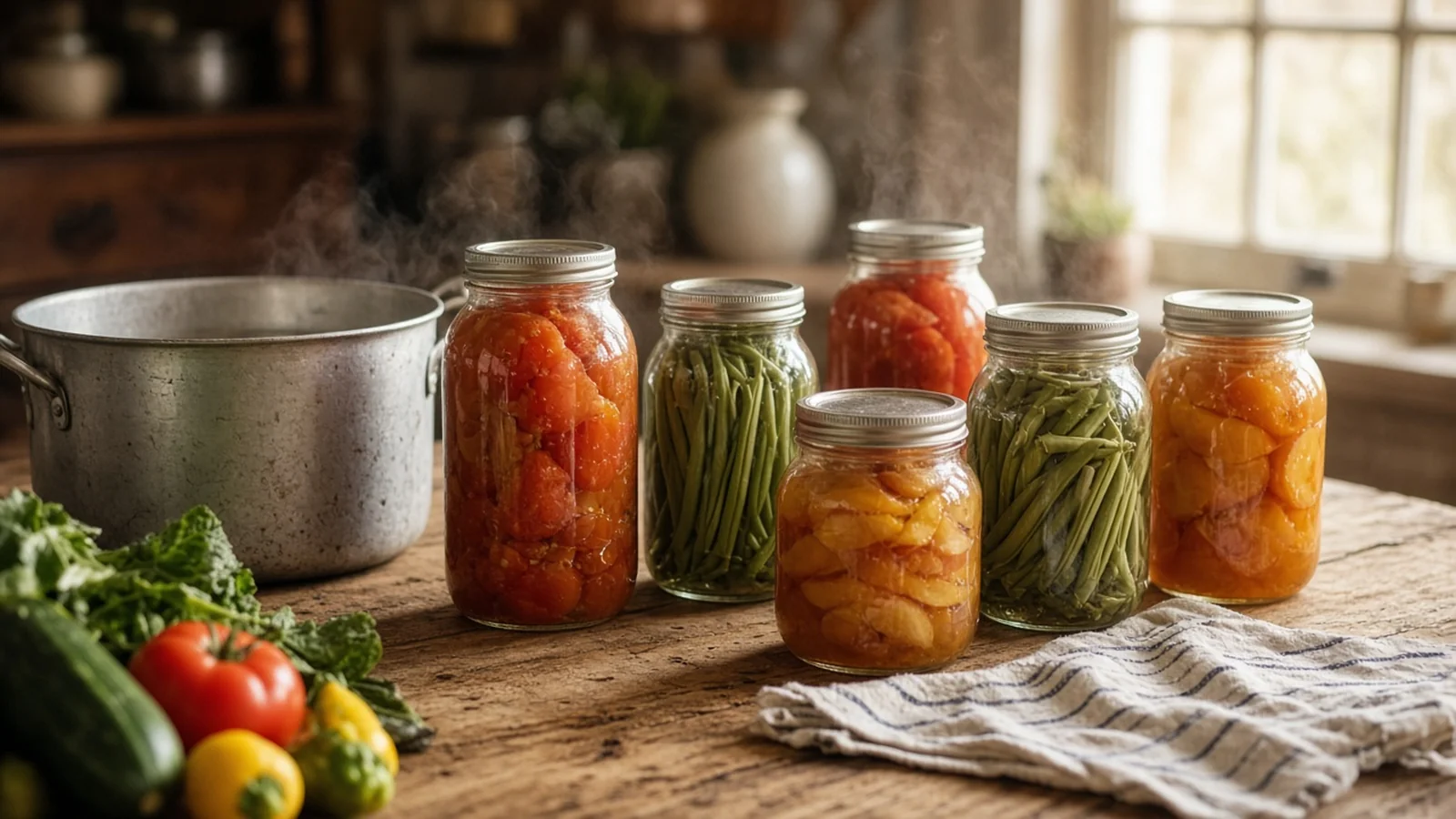
Growing food is only half of an off-grid food system. The other half is keeping it. A chest freezer is the usual answer, but it is also one of the steadiest loads on a solar battery bank, and it fails the moment the power does. Canned food sits on a shelf, uses no electricity once it's sealed, and keeps the summer garden feeding you through winter.
Canning is also the one preservation method where a small shortcut can make people seriously ill. This guide covers the rules the USDA and the National Center for Home Food Preservation (NCHFP) publish, in plain language, so your first season of jars is a safe one.
The one rule that decides everything: acid
Whether a food goes in a boiling-water canner or a pressure canner depends on its acidity, measured as pH. The lower the pH, the more acidic the food.
| Group | pH | Examples (from NCHFP) | Method |
|---|---|---|---|
| Acid foods | 4.6 or lower | Fruits, pickles, sauerkraut, jams, jellies, marmalades, fruit butters | Boiling-water canner |
| Low-acid foods | Above 4.6 | Red meats, seafood, poultry, milk, and all fresh vegetables except most tomatoes | Pressure canner only |
| Borderline | Slightly above 4.6 | Some tomatoes, figs | Boiling-water canner only after acidifying with lemon juice or citric acid |
The reason is Clostridium botulinum. NCHFP explains that its spores survive in soil and water for years, and in a sealed jar of moist, low-acid food held between 40 °F and 120 °F with almost no oxygen, they can produce a deadly toxin within 3 to 4 days. The spores are very hard to destroy at boiling temperature. Low-acid foods need 240 °F to 250 °F, which a home kitchen can only reach inside a pressure canner run at 10 to 15 pounds of pressure.
The CDC adds that home-canned vegetables are the most common cause of botulism outbreaks in the United States.
Boiling-water canning: the easy starting point
If you're new, start with acid foods. Jams, pickles, salsa made from a tested recipe, and acidified tomatoes all go in a boiling-water canner, which is just a deep pot with a rack. NCHFP lists processing times for acid foods from about 5 to 85 minutes, depending on the food and jar size.
Good first projects for a homestead garden are cucumber pickles, fruit jam, applesauce and crushed tomatoes with added lemon juice or citric acid.
Pressure canning: the method for vegetables and meat
Green beans, corn, potatoes, carrots, soups, stock, meat and beans must be pressure canned. The USDA's Complete Guide to Home Canning is blunt: pressure canning is the only recommended method for meat, poultry, seafood and vegetables. At 240 °F to 250 °F, processing times run from 20 to 100 minutes. In a boiling-water canner, the same foods would need 7 to 11 hours, which is why that isn't a safe substitute.
What the CDC tells home canners about equipment:
- Use a real pressure canner that holds at least four 1-quart jars upright on the rack.
- Don't use an electric multi-cooker for canning, even if it has a "canning" or "steam canning" button.
- Keep the gauge accurate. Many county Extension offices will test dial gauges.
- Vent the canner before pressurizing and let it cool the recommended way. Don't force-cool it.
- Use current recipes. Old family recipes often use times and pressures that are no longer considered safe.
Adjust for altitude
Water boils at a lower temperature as you go up, and lower temperatures kill fewer bacteria. NCHFP says sea-level times can lead to spoilage at 1,000 feet and above, so you add time (boiling-water canning) or pressure (pressure canning) for your elevation. A lot of off-grid land is high country, so look up your elevation before your first batch. If you don't know it, your county Extension office can tell you.
When in doubt, boil it
The USDA and CDC both give the same safety net. If you aren't sure a jar of low-acid food or tomatoes was processed exactly right, boil the contents in a saucepan before eating: 10 minutes below 1,000 feet, plus 1 minute for each additional 1,000 feet. Never taste a suspect jar first. A bulging lid, a broken seal, leaking, spurting liquid or an off smell means throw it out, carefully.
How canning fits an off-grid food system
A simple, resilient plan looks like this:
- Grow for storage, not just for salads. Plant enough tomatoes, beans, cucumbers and fruit to put up, not only to eat fresh.
- Can the acid foods first. A boiling-water canner works on a wood or propane stove, so you don't need grid power.
- Add a pressure canner once you're confident, for beans, corn, stock and meat.
- Keep the freezer small. Shelf-stable jars mean you can size a smaller freezer, which takes load off your batteries. Our battery bank calculator shows what each appliance costs you in storage.
- Label and rotate. Mark every jar with its contents and date, and eat the oldest first.
What to use or read
Preserving well starts with growing well. Two books in our Regenerative Library are the standard references for productive small-scale gardens:
- The New Organic Grower by Eliot Coleman, a manual of tools and techniques for small-scale organic growing, for home gardens and market farms.
- The Market Gardener by Jean-Martin Fortier, a handbook of low-tech, high-yield methods for intensive vegetable growing on a small plot.
For the canning recipes themselves, use the USDA Complete Guide to Home Canning, which NCHFP publishes free online. Then see the Food hub for planning steps and expert videos.
Sources
- National Center for Home Food Preservation, University of Georgia. "Ensuring Safe Canned Foods." nchfp.uga.edu
- USDA. Complete Guide to Home Canning, Guide 1: Principles of Home Canning. PDF via NCHFP
- Centers for Disease Control and Prevention. "Home-Canned Foods and Botulism." cdc.gov