
Living off the grid with solar power is very doable. What trips most beginners up is the order they do things in. They shop for panels first and figure out what they actually need to power later. That order gets expensive fast. You decide how much electricity your house will use, then size the system to your worst month of sun. The hardware comes last.
This plan walks through that order step by step, with real numbers at each step. Electricity use comes from the U.S. Energy Information Administration and a utility appliance chart, sun hours from NASA, and kit prices from each seller's own page, checked on November 12, 2026. Seller pages stay as the source for prices.
Short answer
- An average US home uses about 899 kWh a month (EIA, 2022), or roughly 30 kWh a day. Powering that from off-grid solar takes a very large system: about 8 kW of panels and 74 kWh of battery in Denver, with even more for winter.
- A lean off-grid home can run on about 4.6 kWh a day if heat, hot water, cooking and clothes drying run on propane, wood or sun instead of electricity. That's about one sixth of the average.
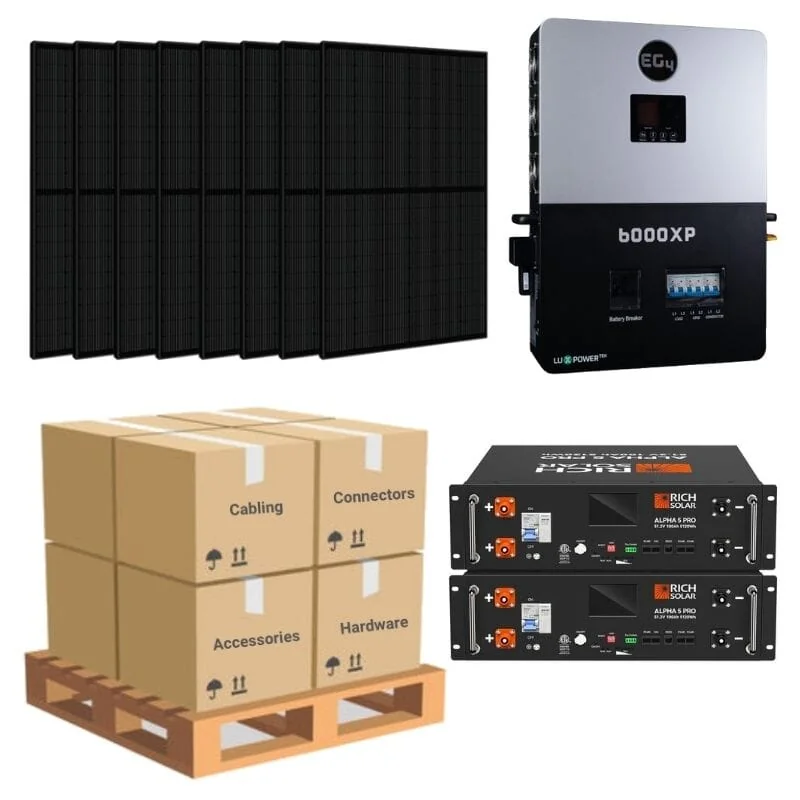
- For that lean home in Denver, plan on roughly 2.7 kW of panels to cover December and about 12 kWh of battery for two cloudy days. A complete kit in that range, the ShopSolar PRIME PLUS, starts at $6,089.
- Plan on a generator anyway. The US Department of Energy's guidance suggests designing a stand-alone system to cover about 80% of your energy and using fuel for the other 20%.
What to use: For the design math in this plan, worked through in more depth, see Solar Electricity Handbook in our Regenerative Library.
What an off-grid solar system is
An off-grid ("stand-alone") system isn't connected to the utility at all, so it has to store its own power for nights and cloudy days. Every system, from a shed to a farmhouse, has the same four parts:
- Solar panels (the array) make DC electricity in daylight.
- A charge controller feeds that power into the batteries without overcharging them. In most modern systems it's built into the inverter.
- A battery bank stores energy for night and bad weather. Today that usually means lithium iron phosphate (LiFePO4).
- An inverter turns battery DC into the 120V (or 120/240V) AC that normal outlets and appliances use.
Then add the wiring, fuses, breakers, disconnects and racking that tie them together safely. Most people living off grid also keep a generator for the darkest weeks of winter.
Step 1: Measure what you use now
Start with real numbers. Pull 12 months of your electric bills and note the kWh used each month, especially in winter. Divide a month's kWh by 30 to get kWh per day. If your highest month is 1,200 kWh, that's 40 kWh a day, and that's the number solar has to beat.
For comparison, EIA puts the average US residential customer at 10,791 kWh a year (about 899 kWh a month) in 2022, ranging from 6,178 kWh a year in Hawaii to 14,774 kWh in Louisiana. Divide by 365 and that's roughly 17 to 40 kWh a day.
If you're planning a new build or don't have bills, list each appliance with its watts and hours a day. Watts × hours = watt-hours a day. Our off-grid solar calculator does this math for you.
Step 2: Cut your loads before you buy anything
This step saves you more money than any other. Every kWh you don't use a day saves you panels, battery and inverter capacity. And the biggest loads in a typical house are the ones that make heat.
FirstEnergy's appliance chart (based on average size and use) shows how lopsided this is:
| Appliance | Watts | Typical kWh a month |
|---|---|---|
| Water heater, 40 gal. | 4,500 | 337.5 |
| Furnace fan | 295 | 212.4 |
| Portable space heater | 1,320 | 102.6 |
| Refrigerator | 225 | 64.8 |
| Clothes dryer | 2,790 | 41.2 |
| Microwave oven | 1,500 | 22.5 |
| LED TV, 60 inch | 88 | 21.6 |
| Well pump | 725 | 10.2 |
| Clothes washer | 255 | 4.6 |
The electric water heater alone is about 11 kWh a day, more than twice our whole lean home below. That's why most off-grid homes:
- Heat water and the house with propane, wood or solar thermal, not electric resistance. Our wood stove vs rocket mass heater guide covers the two main wood-heat options.
- Cook with propane or a wood stove, using electricity only for small appliances.
- Dry clothes on a line or with a gas dryer.
- Buy the most efficient refrigerator they can. It runs all day, every day, so it's usually the biggest load left.
- Switch to LED lighting and get rid of devices that draw power on standby.
Step 3: Add up your new daily load
Here's an example lean off-grid home after those changes. Watts and monthly hours come from the FirstEnergy chart, divided by 30 for hours a day; the lighting hours are our own assumption.
| Load | Watts | Hours a day | Wh a day |
|---|---|---|---|
| Refrigerator | 225 | 9.6 | 2,160 |
| 8 LED bulbs (13W each) | 104 | 4 | 416 |
| LED TV, 60 inch | 88 | 6 | 528 |
| Laptop, 15 inch | 60 | 2 | 120 |
| Microwave | 1,500 | 0.5 | 750 |
| Clothes washer | 255 | 0.6 | 153 |
| Well pump | 725 | 0.47 | 338 |
| Coffee maker | 1,000 | 0.17 | 167 |
| Total | 4,632 Wh (about 4.6 kWh) |
That's about 139 kWh a month, around 15% of the national average. Your number will differ, so use your own list. But it shows what living off the grid with solar usually looks like in practice: a normal fridge, lights, electronics, laundry and water, with heat coming from somewhere else.
If you have a deep well pump, see our solar well pump sizing guide. It can change your inverter choice (see Step 6).
Step 4: Size the panels for your worst month
Peak sun hours are how many hours a day your panels get the equivalent of full midday sun. They change a lot by season, and winter decides the array size if you live off grid year-round.
The quick formula: array kW = daily kWh ÷ (sun hours × 0.75). The 0.75 allows about 25% for wiring, heat, dirt and battery charging losses. Sun hours below are NASA POWER's 2001–2025 averages for flat ground in each state capital, which lean conservative, because tilted panels collect more in winter.
| City | Sun hours (year / worst month) | Lean home, 4.6 kWh a day (year / worst month) | Average home, about 30 kWh a day (year / worst month) |
|---|---|---|---|
| Phoenix, AZ | 5.85 / 3.08 | 1.1 kW / 2.0 kW | 6.7 kW / 12.8 kW |
| Austin, TX | 4.81 / 2.74 | 1.3 kW / 2.3 kW | 8.2 kW / 14.4 kW |
| Denver, CO | 4.85 / 2.29 | 1.3 kW / 2.7 kW | 8.1 kW / 17.2 kW |
| Atlanta, GA | 4.51 / 2.37 | 1.4 kW / 2.6 kW | 8.7 kW / 16.6 kW |
| Nashville, TN | 4.23 / 1.92 | 1.5 kW / 3.2 kW | 9.3 kW / 20.5 kW |
| Boise, ID | 4.56 / 1.39 | 1.4 kW / 4.4 kW | 8.7 kW / 28.4 kW |
| Helena, MT | 4.01 / 1.17 | 1.5 kW / 5.3 kW | 9.8 kW / 33.7 kW |
| Montpelier, VT | 3.47 / 1.06 | 1.8 kW / 5.8 kW | 11.4 kW / 37.2 kW |
Two things jump out:
- The lean home is affordable almost everywhere on yearly sun, and still reasonable in winter across the southern half of the country.
- In the northern states, covering the darkest month with panels alone gets huge. Helena's December has less than a third of its yearly average sun. This is where the DOE's 80/20 rule earns its keep. Size the array for spring and fall, and let a generator cover the dark weeks.
Step 5: Size the battery bank
The battery carries you through the night and through cloudy stretches. The DOE's consumer guide says off-grid battery banks are typically sized for one to three days of operation.
The formula: battery kWh = daily kWh × days of backup ÷ usable fraction. LiFePO4 batteries are commonly run down to about 80%, so:
- Lean home: 4.6 kWh × 2 days ÷ 0.8 = about 11.6 kWh.
- Average home: 29.6 kWh × 2 days ÷ 0.8 = about 74 kWh, more than twice the battery in the largest kit below.
Two practical notes. Most LiFePO4 batteries shouldn't be charged below freezing, so keep them indoors or buy models with built-in heating. And never use car batteries. The DOE notes they're shallow-cycle batteries that fail quickly when drained deeply over and over. Our LiFePO4 battery guide and battery bank calculator cover the details.
Step 6: Pick the inverter and system voltage
The inverter has to handle everything that runs at the same time, plus the brief surge when a motor starts. In our lean home, the microwave (1,500W), fridge (225W) and well pump (725W) could all run together, which comes to about 2,450W. That's why a 3,000W inverter is a sensible minimum and 6,000W gives real headroom.
Two choices matter most:
- 120V or 120/240V? Many deep well pumps, mini-split heat pumps and shop tools need 240V. A split-phase inverter gives you both. Check your pump's label before you buy.
- 12V, 24V or 48V battery? Small systems run on 12V. Anything house-sized should be 48V, because higher voltage means lower current, thinner wire and less loss.
For a deeper look, see Off-Grid and Hybrid Inverters Explained.
Step 7: Choose a kit or a custom build
Beginners are usually better off with a complete kit. The panels, batteries and inverter are already matched, so they agree on voltage and current. Here are real kits across the size range, with prices checked on November 12, 2026:
| Kit | Price | Array | Battery | Inverter | 240V? |
|---|---|---|---|---|---|
| ShopSolar CORE PLUS | $2,549 / $3,089 | 800W | 5 or 7 kWh (24V LFP) | Rich Solar 3,000W | No |
| ShopSolar CORE MAX | $4,389 / $4,989 | 1.6 kW | 5 or 7 kWh (24V LFP) | 2 × Rich Solar 3,000W | No |
| Renogy 1.2kW Cabin Solution | $4,999.99 | 1,280W | 10.24 kWh | Renogy 3,500W, 48V | No |
| ShopSolar CORE PRO | $5,989 | 3.2 kW | 10 kWh | Rich Solar 6,000W | Yes |
| ShopSolar PRIME PLUS | $6,089–$8,709 | 4.4 kW | 10–16 kWh | EG4 6000XP | Yes |
| Renogy 2.5kW Cabin Solution | $8,449.99 | 2,560W | 20.48 kWh | Renogy 3,500W, 48V | No |
| ShopSolar PRIME MAX | $10,539–$16,189 | 7.92 kW | 16 kWh | EG4 12kPV hybrid | Yes |
| ShopSolar PRIME PRO | $15,289–$22,789 | 10.56 kW | 28–32 kWh | EG4 18kPV hybrid | Yes |
ShopSolar listed its CORE kits at sale prices, below "was" prices of $3,539 (CORE PLUS, 5 kWh), $5,979 (CORE MAX, 5 kWh) and $8,549 (CORE PRO). The lowest PRIME prices are the options without racking. Prices change often, so confirm the exact setup on the seller's page.
What those arrays make per day (array kW × sun hours × 0.75), year-average and December, using the sun hours above:
| Array | Denver | Nashville | Helena |
|---|---|---|---|
| 1.6 kW | 5.8 / 2.7 kWh | 5.1 / 2.3 | 4.8 / 1.4 |
| 3.2 kW | 11.6 / 5.5 | 10.2 / 4.6 | 9.6 / 2.8 |
| 4.4 kW | 16.0 / 7.6 | 14.0 / 6.3 | 13.2 / 3.9 |
| 7.92 kW | 28.8 / 13.6 | 25.1 / 11.4 | 23.8 / 6.9 |
| 10.56 kW | 38.4 / 18.1 | 33.5 / 15.2 | 31.8 / 9.3 |
Matching the plan to a kit:
- Lean home, sunny half of the US: CORE PRO (3.2 kW, 10 kWh, 240V) or PRIME PLUS (4.4 kW, 10–16 kWh, 240V) covers 4.6 kWh a day even in a Denver or Nashville December, with room for a little growth.
- Lean home, northern states: PRIME PLUS on yearly sun, plus a generator for December and January. Or step up to PRIME MAX.
- Average-size home: even PRIME PRO falls short of 30 kWh a day in winter almost everywhere in our table, and its battery is under half of the 74 kWh two-day bank. Cut loads first (Step 2), then size up.
For the full comparison, see Off-Grid Solar Kits: Complete Systems Compared. For small buildings, see Off-Grid Cabin Solar.
Step 8: Permits, installation and backup
- Check with your county first. Building and electrical permits, inspections and setback rules vary widely, even for systems that never connect to a utility. Some counties also have rules about living full-time on land without a utility hookup.
- Plan the install. Many kits are built for DIY mounting and wiring. Still, have a licensed electrician make the final connections and check the work against code. It's safer, and an inspector or insurer may require it.
- Budget for what kits leave out: racking (on some kits), the house's AC wiring and panel, trenching and conduit, and labor.
- Add a generator input. Before you order, confirm on the spec sheet that the inverter can charge the batteries from a generator (an AC input). A small propane or gas generator turns a winter shortfall into a few hours of runtime instead of a dead battery.
Mistakes to avoid
- Sizing from summer sun or yearly averages when you live there all winter.
- Keeping electric heat, an electric water heater or an electric dryer. They can triple the system size.
- Buying 120V-only when the well pump or heat pump needs 240V.
- Putting batteries in an unheated shed without checking their charging temperature limits.
- Skipping the backup plan. Plan for a generator, or for cutting back during long cloudy stretches.
Run your own numbers with the off-grid solar calculator, then come back to Step 7 to match a kit.
Sources
- U.S. Energy Information Administration: How much electricity does an American home use?: 10,791 kWh a year (about 899 kWh a month) average in 2022, with state highs and lows. Checked November 12, 2026.
- FirstEnergy: Understanding Electricity Usage & Costs: appliance watts and typical monthly hours and kWh. Checked November 12, 2026.
- U.S. Department of Energy, Office of Energy Efficiency and Renewable Energy: Clean Energy Choices: Tips on Buying and Using Renewable Energy at Home: the 80/20 design rule, battery banks typically sized for one to three days, and deep-cycle vs. automotive batteries. Checked November 12, 2026.
- NASA POWER all-sky surface irradiance, 2001–2025 climatology for state capitals, as used in our off-grid solar calculator (pulled November 3, 2026).
- ShopSolar: CORE PLUS, CORE MAX, CORE PRO, PRIME PLUS, PRIME MAX, PRIME PRO: prices checked November 12, 2026; array, battery and inverter specs from the same pages.
- Renogy: 1.2kW Cabin Solution and 2.5kW Cabin Solution: prices checked November 12, 2026; specs from the same pages.