
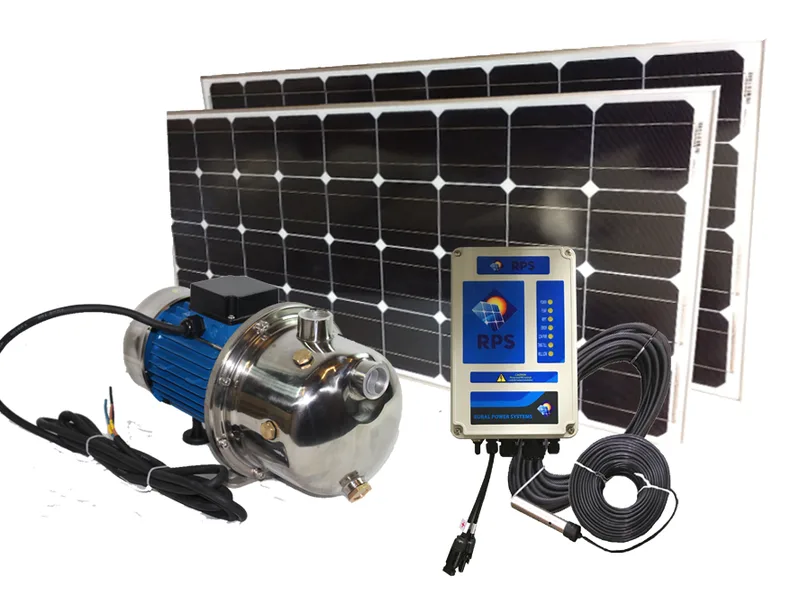
Not every off-grid water job starts at the bottom of a well. A lot of the time the water is already on the surface: in a pond, a creek, a spring box, a rain tank or a cistern. You just need to move it somewhere useful. That might be up to a header tank, out to a cattle trough, through a drip line, or round and round a pond to keep it from going green.
That's the job of a solar water pump that sits at or near the surface. It is usually simpler and cheaper than a deep well system, but it has its own rules, mostly about suction and pressure. Get those wrong and even a big pump will barely trickle.
This guide shows how to size one, then compares eight real pumps and kits, from an $80 fountain pump to a 3 hp irrigation system. Every price and spec below comes from the seller's own product page and was checked on November 16, 2026. Several were on sale that day, so treat the seller's page as the final word.
If your water is in a drilled well, read solar well pump kits: how to pick and size one instead.
Short answer
- Small garden pond or water feature: ECO-WORTHY 25W Solar Fountain Pump Kit, listed on Amazon at $79.99. Up to 449 gallons per hour, but only about 10 feet of lift.
- Cheapest real transfer pump kit: ROCKSOLAR 0.4 HP 20–40V Transfer Pump Kit at $649.99, with one 445W panel. Up to 8.8 GPM.
- Pushing water uphill to a far tank: ROCKSOLAR 1.07 HP 40–90V Transfer Pump Kit at $1,299.99. Rated to 203 feet of head.
- More volume at lower lift: ROCKSOLAR 1.07 HP 65–110V Transfer Pump Kit at $1,459.99. Up to 24.2 GPM.
- Best published flow chart for tanks, troughs and drip: RPS T400 / T800 Solar Transfer Pump Kit at $2,232.49 (T400) or $2,602.99 (T800).
- Pond aeration fountain: RPS F200 / F400 Solar Fountain Pump at $1,833.49 or $2,070.99.
- Pumping after sunset, from a tank or pond: ROCKSOLAR 500W 24V Off-Grid Pump Kit at $1,599.99, which includes a 24V 50Ah LiFePO4 battery.
- Sprinklers and pasture irrigation: RPS Pro Irrigation Surface Pump, from $4,569.49 (ProS750) to $7,295.99 (ProS3000).
What to use: For a small pond, birdbath, aquaponics tank or rain-barrel water feature where the water only needs to rise a few feet, the ECO-WORTHY 449 GPH solar fountain pump kit on Amazon is the simple starting point. It's plug-and-play with its own panel and has dry-run protection. It does not include a battery, so it stops when the sun does.
Surface, submersible and fountain pumps
Solar water pumps for tanks and ponds come in three basic types:
- Surface (transfer) pumps sit on dry ground next to the water and pull it in through a suction hose. RPS, for example, describes its T-series pump as one that can "attach to the outlet of any storage tank" or lift water by suction from ponds, springs, creeks and shallow wells. They're easy to reach for maintenance, but they need a foot valve and can only pull water up a limited height.
- Submersible pumps sit under the water and push it. They never lose prime and don't care how far below them the water surface sits, but you have to pull them out to service them. Small fountain pumps are submersible, and so are the 3-inch well-style pumps that people often drop into ponds and cisterns.
- Fountain and aerator pumps are submersible pumps built to throw water into the air. That spray mixes oxygen into a pond. They're not meant to move water anywhere.
The rule that matters most: a surface pump can push water a long way up, but it can only pull it a short way up. RPS rates its T400/T800 for suction up to 15 feet and its Pro irrigation pumps up to 25 feet, and says on the Pro page that "the less priming, the better GPM production." If the pump would sit more than about that far above the water, put the pump in the water instead.
Step 1: How many gallons a day?
Size for your busiest week of summer, when gardens and animals drink the most.
- Cattle. Kansas State University's livestock watering handbook says to plan on at least 10 gallons per 1,000 lb animal per day in mild and cold weather, and up to 20 gallons per day in hot weather. Colorado State University Extension uses about 20 gallons a day for a cow/calf pair in summer, so 50 pairs need about 1,000 gallons a day.
- People. New Mexico State University's solar pumping guide uses about 75 gallons per person per day for drinking, cooking and bathing.
- Garden. One inch of water over one square foot is about 0.62 gallons (1/12 of a cubic foot × 7.48 gallons per cubic foot). So one inch a week over a 1,000 sq ft garden is about 620 gallons a week, or roughly 90 gallons a day. Your local extension office can tell you how much water your crops need where you live.
- Pond aeration. There's no gallons-per-day number here. You size by pond area and the pump maker's guidance (see the RPS fountain below).
Step 2: Total head (and why psi counts)
A pump's flow drops as it has to push harder. Makers rate this with head, in feet. Total head is:
- Suction lift: from the water surface up to the pump (surface pumps only).
- Rise: from the pump up to the highest point the water reaches, such as the inlet of a hilltop tank.
- Pressure: if water has to come out under pressure (sprinklers, drip emitters, a pressure tank), each 1 psi is about 2.31 feet of head. RPS's own T400/T800 chart pairs 50 feet of head with 22 psi and 100 feet with 43 psi.
- Friction: long runs of narrow pipe add head. Use your pipe maker's friction-loss chart for your pipe size and flow.
A drip line running at 20 psi adds about 46 feet of head before any hill. Spraying sprinklers at 45 psi adds about 104 feet. That's why the irrigation pumps at the end of this list are so much bigger than the trough pumps at the start.
Step 3: Gallons a day to gallons a minute
A solar-direct pump only runs well in good sun. RPS rates its kits on a 6-hour solar pumping day: gallons per day = gallons per minute × 60 × 6. Virginia Tech's extension guide uses the same idea with your own site's peak sun hours: daily need ÷ (peak sun hours × 60) = the flow rate you need.
Example: 600 gallons a day ÷ (6 × 60) ≈ 1.7 GPM at your total head. For your own sun hours, use our off-grid solar calculator.
Step 4: Store water, not electricity
The cheapest "battery" for a solar pump is a tank. Pump all day into a tank above the point of use, then let gravity do the rest at night. NMSU's guide suggests storage of 3 to 10 days of water use depending on climate and use, with the long end for household water in cloudy places. Colorado State notes that a system for 50 cow/calf pairs "can easily reach $10,000," so it's worth getting the storage right before you buy a bigger pump.
Batteries make sense when you need water pressure after dark or on demand, such as a cabin tap. See the ROCKSOLAR battery kit below.
Eight solar water pumps compared
Prices and specs from each seller's own page, checked November 16, 2026.
| Pump or kit | Type | Price | Solar included | Rated max flow | Rated max head | Notes |
|---|---|---|---|---|---|---|
| ECO-WORTHY 25W Fountain Pump Kit | Small submersible | $79.99 (Amazon) | 25W panel | 449 GPH (≈7.5 GPM) | 10.17 ft | Dry-run protection, 16 ft cord, no battery |
| ROCKSOLAR 0.4 HP 20–40V Transfer Kit | Surface | $649.99 | 1 × 445W | 8.8 GPM | 98.4 ft | 1 in outlet, float/pressure switch compatible |
| ROCKSOLAR 1.07 HP 40–90V Transfer Kit | Surface | $1,299.99 | 2 × 445W (890W) | 9.6 GPM | 203 ft | IP54 pump, IP65 controller |
| ROCKSOLAR 1.07 HP 65–110V Transfer Kit | Surface | $1,459.99 | 3 × 445W (1,335W) | 24.2 GPM | 98 ft | Controller up to 262 ft from pump |
| ROCKSOLAR 500W 24V Off-Grid Kit | 3 in submersible + battery | $1,599.99 | 1 × 445W | 15.3 GPM | 130 ft | 24V 50Ah LiFePO4, 20A MPPT controller |
| RPS F200 / F400 Fountain | Fountain aerator | $1,833.49 / $2,070.99 | 2 or 4 × 100W | n/a | n/a | Fountains up to 6 ft tall, 8 ft wide |
| RPS T400 / T800 Transfer Kit | Surface | $2,232.49 / $2,602.99 | 4 or 8 × 100W | 13.2 / 13.5 GPM | See chart | Suction up to 15 ft, about 40 psi in full sun (T400) |
| RPS Pro Irrigation (ProS750–ProS3000) | Surface, 3-phase | $4,569.49–$7,295.99 | 1.6–3.1 kW | 46–110 GPM at 25 ft | 120 ft on chart | Suction up to 25 ft, sprinklers up to 45 psi |
ROCKSOLAR notes on its transfer pump pages that "maximum flow and maximum head are separate ratings and do not occur at the same operating point." In plain terms: you get the high flow only near zero lift, and almost no flow near the maximum head. ROCKSOLAR doesn't print a full flow chart on those pages, so ask for the pump curve before buying if your head is more than a third or so of the maximum. RPS does print one.
RPS T400 and T800: flow at each head
From the RPS product page, based on a 6-hour solar pumping day:
| Head (ft) | psi | T400 GPM | T400 gal/day | T800 GPM | T800 gal/day |
|---|---|---|---|---|---|
| 0 | 0 | 13.2 | 4,752 | 13.5 | 4,860 |
| 10 | 4 | 12.1 | 4,356 | 12.6 | 4,536 |
| 25 | 11 | 8.9 | 3,204 | 10.2 | 3,672 |
| 50 | 22 | 3.2 | 1,152 | 9.8 | 3,528 |
| 75 | 32 | n/a | n/a | 6.5 | 2,340 |
| 100 | 43 | n/a | n/a | 1.9 | 684 |
This table shows why head matters so much. At 25 feet the T400 and T800 are close. At 50 feet the T800, with twice the solar, moves about three times as much water. RPS's advice on the page is to size up to the next model if you know you'll need more pressure later, for example moving from 20 psi drip lines to 60 psi sprinklers.
What's in the box: the panels (four for the T400, eight for the T800), the RPS pump controller, a brushless pump with 1-inch FNPT inlet and outlet, 20 feet of MC4 wire, pump wire, and the manual. A foot valve is not included. RPS sells a suction hose and foot valve kit from $89.00 (5 feet, 1-1/4 inch). RPS also sells a T800 kit without panels for $1,823.99 if you already have them.
RPS Pro Irrigation: flow at each head
The Pro series uses US 3-phase pumps with a 2.2 kW controller that can also run from a 3,000W, 220V single-phase generator. RPS's chart (under 5 feet of suction, 6-hour day):
| Head (ft) | ProS750 | ProS1000 | ProS1500 | ProS2000 | ProS3000 |
|---|---|---|---|---|---|
| 25 | 46 GPM | 60 | 64 | 88 | 110 |
| 50 | 43 | 52 | 63 | 86 | 105 |
| 75 | 34 | 42 | 60 | 79 | 93 |
| 100 | 10 | 27 | 44 | 63 | 72 |
| 120 | n/a | n/a | n/a | 40 | 45 |
Prices that day: ProS750 $4,569.49, ProS1000 $4,977.99, ProS1500 $5,424.49, ProS2000 $6,279.49, ProS3000 $7,295.99. Two things to know before you buy: RPS says the Pro series is not compatible with batteries, and solar panel mounting is a separate cost. The copper grounding rod is also customer-supplied.
RPS F200 and F400 pond fountains
These are 3-inch stainless submersible pumps with an internal controller, stainless cluster and blossom nozzles, 100 feet of pump wire already attached, 100 feet of anchoring rope, and either two (F200) or four (F400) 100W panels. RPS says they make fountains up to 6 feet tall and 8 feet wide and add roughly 5 to 10 pounds of oxygen a day. They carry a two-year warranty.
RPS's sizing advice for ponds of 1 acre or more is to start with one fountain and wait to see if you need a second. For long, narrow or odd-shaped ponds, it suggests several smaller fountains instead of one big one. Like any solar-direct pump, they run only while the sun is up. For aeration around the clock, RPS sells separate solar air-compressor kits.
ROCKSOLAR transfer pump kits
ROCKSOLAR's three brushless transfer kits all include their pump, an external controller, Hanersun 445W bifacial panels (67.80 × 44.65 × 1.18 in, 51.4 lb each), a 10-foot PV cable and a PV combiner box with a 32A breaker and surge protector. All three have dry-run, overload and overvoltage protection, and all work with a float switch or pressure switch, so the pump can stop when a trough or tank is full and restart when the level drops.
- 0.4 HP, 20–40V ($649.99): one panel, 8.8 GPM max, 98.4 ft max head, 1-inch outlet. ROCKSOLAR lists garden fountains, small ponds, troughs, small pools and irrigation as uses, and says it can be paired with a battery.
- 1.07 HP, 40–90V ($1,299.99): two panels, 9.6 GPM max, 203 ft max head. This is the one for pushing water up a big hill to a high tank.
- 1.07 HP, 65–110V ($1,459.99): three panels, 24.2 GPM max but only 98 ft max head, and up to 262 feet of cable between the controller and the motor. Better for moving lots of water at low lift.
ROCKSOLAR 500W 24V kit with battery
This kit pairs a 3-inch, 0.4 HP brushless submersible pump (15.3 GPM max, 130 ft max head, 1.5-inch outlet) with a 24V 50Ah LiFePO4 battery, a 20A MPPT charge controller and one 445W Hanersun panel. ROCKSOLAR notes that "500W" is just the kit name; the included panel is rated 445W. The battery's listed charging range is 0°C to 45°C (32°F to 113°F), so don't count on it charging in a freezing pump house. It's the only kit here that comes ready to pump after dark.
Which one fits your job
- Small garden pond, birdbath or aquaponics tank: ECO-WORTHY 25W kit.
- Fill a stock tank from a pond or creek, short lift: ROCKSOLAR 0.4 HP kit or RPS T400.
- Pump from a pond up a long hill to a storage tank: ROCKSOLAR 1.07 HP 40–90V kit or RPS T800. Check the head chart first.
- Run drip irrigation from a rain tank: RPS T400 or T800. Remember to add the emitter pressure to your head.
- Water pastures with sprinklers: RPS Pro Irrigation series.
- Keep a farm pond clear and oxygenated: RPS F200 or F400.
- Need water after dark: ROCKSOLAR 500W 24V kit, or put a tank uphill and let gravity work at night.
Before you buy
- Measure the real numbers. Get the vertical rise with a laser level or a phone GPS app, and measure the pipe run. Don't guess the head.
- Keep suction short. Put a surface pump as close to the water and as low as you safely can, and keep the suction hose airtight. Use a foot valve with a screen.
- Protect the intake. Keep the intake off the bottom of the pond, out of the mud.
- Add a float switch. A full tank shouldn't overflow all afternoon. Both RPS and ROCKSOLAR controllers work with tank switches.
- Prevent backflow. The USDA NRCS beef grazing water guide says any tank or waterer fed from a well or water district line should have a vacuum break or backflow device. Check your local code too.
- Plan for winter. Drain surface pumps and exposed pipe before a hard freeze.
- Fence animals off the pond. NRCS recommends pumping pond or stream water to a pasture tank instead of letting cattle wade in.
For more on storing the water you pump, see our rain barrel water quality guide and the rainwater storage calculator.
Sources
- RPS Solar Pumps product pages (prices, flow charts and specs checked November 16, 2026): T400/T800 Solar Transfer Pump Kit, Pro Irrigation Surface Pump, F200/F400 Solar Fountain Pump, Suction Hose + Foot Valve Kit.
- ROCKSOLAR product pages (checked November 16, 2026): 0.4 HP 20–40V Transfer Pump Kit, 1.07 HP 40–90V Transfer Pump Kit, 1.07 HP 65–110V Transfer Pump Kit, 500W 24V Off-Grid Solar Water Pump Kit.
- Amazon, ECO-WORTHY 25W Solar Water Fountain Pump Kit, 449 GPH (listing, price and specs checked November 16, 2026).
- Kansas State University, KCARE Livestock Watering Handbook: Considerations for sizing a watering system.
- Colorado State University Extension: Solar-powered groundwater pumping systems.
- New Mexico State University, Circular 670: Designing Solar Water Pumping Systems for Livestock.
- Virginia Cooperative Extension, BSE-346: Considerations for Solar-Powered Water Pumping Systems.
- USDA NRCS: Water Resource Development for Managing Intensive Grazing of Beef.