
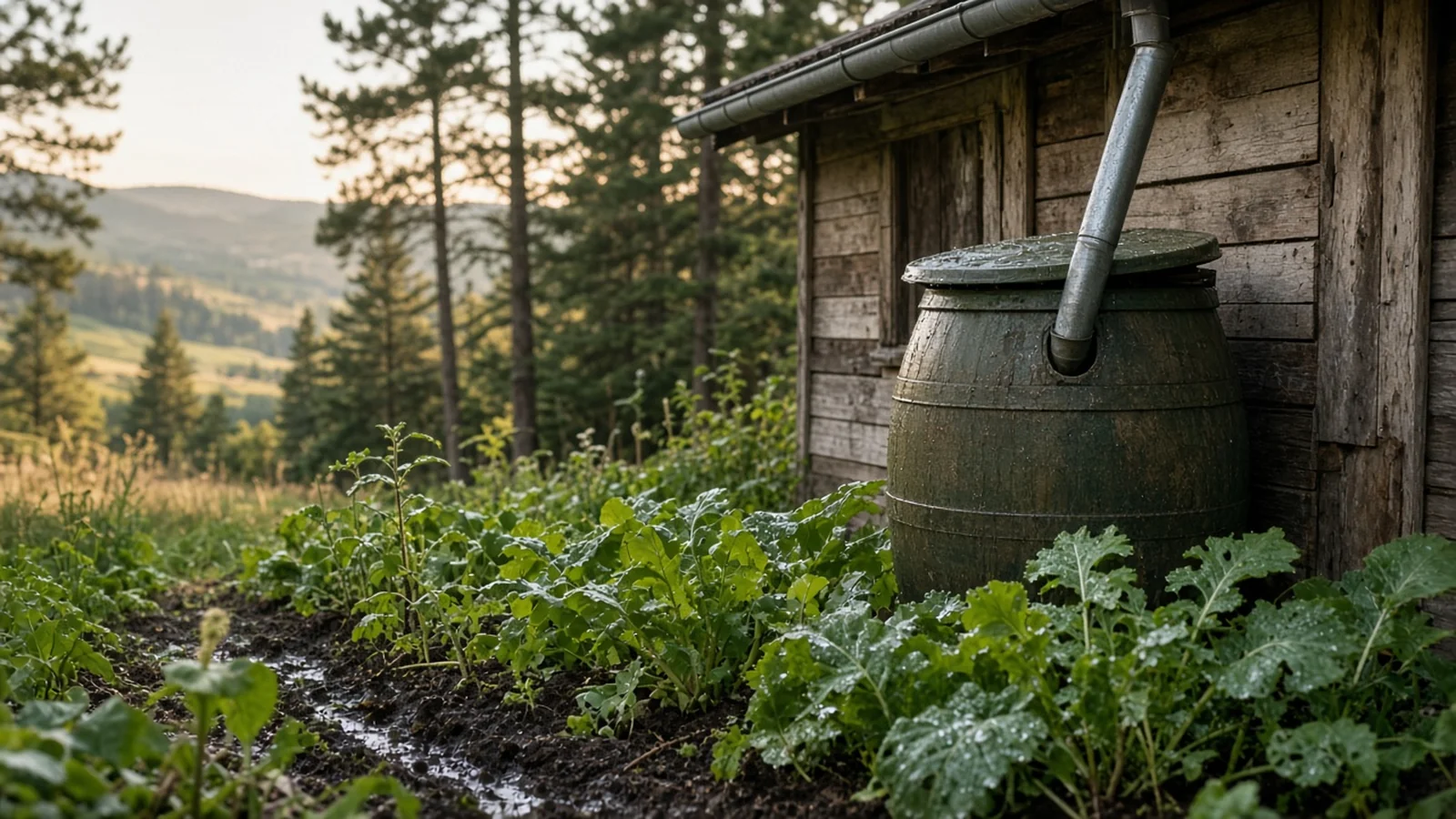
Rain looks clean. It falls from the sky, it has no chlorine, and plants seem to love it. So most people who set up a rain barrel or a cistern assume the water in it is about as pure as water gets.
The water in your tank isn't just rain, though. It's rain that has passed through the air above your town and then run across your roof and gutters. Whatever settled there (dust, soot, metal particles from nearby industry) can end up in the barrel.
A peer-reviewed study published in 2025 in Environmental Research puts real numbers on that for one of the driest, dustiest parts of the US. Researchers at the University of Arizona worked with residents in four Arizona communities to test 577 samples of roof-harvested rainwater for metals. Here's what they found, what it doesn't tell you, and what it means for your own rain barrel.
The study in one paragraph
The samples came from Project Harvest, a community science program that ran from 2016 to 2021. Residents collected water from their own rooftop systems four times a year, at the first and last rains of the winter season and of the summer monsoon, between 2017 and 2020. The four communities were Tucson (an urban area, with most samples from South Tucson), Dewey-Humboldt (home to a legacy mine and smelter Superfund site), and two active copper mining and smelting areas: Globe/Miami and Hayden/Winkelman. For comparison, the team used 162 "background" rain samples from five National Atmospheric Deposition Program sites in remote parks and monuments, collected with a lid that keeps out dust. A university lab tested every sample for 19 dissolved metals and metalloids, including arsenic, lead, cadmium, copper and zinc.
Study type: an observational field study, peer-reviewed and published in Environmental Research (volume 284, 2025). It was funded by the National Science Foundation and the National Institute of Environmental Health Sciences. The authors are clear that it is not a health risk assessment. It measures how contaminated the water is compared with clean background rain, not whether anyone got sick.
What they found
The team scored each sample with a pollution load index (PLI). It compares 11 metals in the barrel water with the clean background rain and rolls them into one number. A PLI above 1 means the harvested water carried more of those metals than background rain did.
1. Roof water was generally dirtier than background rain. The control samples were "generally lower" in metals than water from all four communities. The typical (geometric mean) PLI was:
| Community | Type | Samples | Typical PLI |
|---|---|---|---|
| Hayden/Winkelman | Active copper smelter area | 93 | 2.49 |
| Globe/Miami | Active copper mining area | 124 | 2.43 |
| Tucson | Urban | 307 | 1.65 |
| Dewey-Humboldt | Legacy mine, cleaned up | 53 | 1.18 |
2. Each place had its own fingerprint. Near the Hayden smelter, the biggest jumps over background were in copper (about 15 times background on a typical sample), cadmium and arsenic. In Tucson, zinc and molybdenum stood out, at roughly 9 to 10 times background. The single highest reading of any metal against background was for nickel, at 1,340 times.
3. Distance from the source mattered in mining towns. In Globe/Miami and Hayden/Winkelman, homes farther from the mine or smelter had cleaner water. Beyond roughly 1.5 km, the mining-town water scored below Tucson's. In Tucson, distance from one chosen source didn't predict much, because a city has many sources at once. Between 2017 and 2019 alone, 27 facilities there reported releases to the air, soil or water.
4. Summer storms brought the most metals. In every community, monsoon samples scored higher than winter samples. Across all 577 samples, the median PLI was 2.71 in the monsoon versus 1.46 in winter. The authors link this to dust storms that coat roofs before the rains come, then wash into the tanks.
5. Dustier water was also less acidic, and carried more metals. Monsoon water averaged a pH of 6.13, compared with 5.80 in winter. In Tucson, a higher pH went along with higher levels of most metals measured. The authors explain it by dust: carbonate minerals in dust raise the pH, and the same dust carries metals.
6. Against drinking-water limits, most samples passed, but not all. When the team compared samples with the EPA's drinking-water limits, most landed in the "no pollution" category: 79.2% in Dewey-Humboldt, 78.2% in Tucson, 75% in Hayden/Winkelman and 64.2% in Globe/Miami. Put the other way, roughly a fifth to a third of samples, depending on the town, didn't land there. The scores also shifted a lot depending on which limits they used (drinking, crop irrigation or livestock water).
How did people actually use the water? In an earlier Project Harvest survey quoted in the paper, residents mostly used it for gardening (39%), landscaping (33%) and trees (21%). Less than 1% used it for drinking, dishwashing or bathing.
A second study points the same way
A separate peer-reviewed study from Oklahoma State University and the University of Oklahoma, published in the journal Water in 2024, tested runoff from 19 new small test roofs and two older commercial roofs near busy highways. Roofs included asphalt shingles, sheet metal, clay tile and tar-and-gravel. It also found that pollution falling out of the air was the main source of contaminants in roof runoff. Most samples met EPA guidelines for non-drinking reuse, and trace pesticides and combustion chemicals (PAHs) were far below USGS health screening levels.
Two practical findings stand out from that study. Diverting the first flush of each storm improved water quality and cut PAH levels. And E. coli and other coliform bacteria showed up in the field samples, so the authors recommend treating harvested rainwater first if it will touch people or food crops eaten raw.
What's still unproven
- Arizona isn't everywhere. These four communities were chosen because they sit near mines, smelters or a Superfund site. A rural homestead far from industry may see much lower numbers. The study can't tell you what's in your barrel.
- Metals only. The pollution index leaves out bacteria and organic chemicals. That's a real gap, because microbes are the usual reason people are told not to drink untreated rainwater.
- Not a health study. It shows contamination compared with background rain, not harm. The index also weights all 11 metals equally, though some matter far more to health than others.
- Community-collected samples. Residents took the samples, the sampling frequency wasn't even, and the participants weren't a fully representative group, as the authors note.
- Older data. The samples date from 2017 to 2020. Hayden's smelter was shut by a strike for part of that period and later suspended indefinitely, which may have changed what fell on nearby roofs.
What to do with this on your homestead
1. Know what's upwind. The clearest signal in this study was distance from a big point source. If you're buying land, check for mines, smelters, highways, airports or heavy industry nearby. Our guide to checking a property before you buy covers the soil side of that homework.
2. Fit a first-flush diverter. The first water off the roof carries the most dust and debris. The Oklahoma study found that diverting it improved water quality, and in Arizona the dustiest season brought the most metals.
3. Match the water to the job. Trees, ornamentals and landscaping are the lowest-risk uses, and that's how most Project Harvest households used it. For food crops, water the soil rather than the leaves. Take extra care with greens and anything eaten raw.
4. Don't drink it untreated. Neither study supports drinking roof water as-is. If rainwater is your household supply, treat it and have it tested. Follow your state's rules on rainwater use, and see the planning steps on our Water hub.
5. Keep the system clean. Cover tanks, keep gutters clear and keep overhanging branches cut back. In the Oklahoma study, most E. coli detections came from a flat roof with many geese around it and trees close by.
6. Size storage to your real rain. Our rainwater storage calculator shows how much your roof can catch and how big a tank makes sense. If you pump water from a well too, our solar well pump guide covers the power side.
What to use or try
If you want to design a rain system that works with your site instead of against it, the best place to start is a book written in the same Tucson climate this study measured:
- Rainwater Harvesting for Drylands and Beyond, Volume 1 by Brad Lancaster (3rd edition). It sets out guiding principles for welcoming rain into your landscape, from reading your site to directing runoff and shaping water-wise home grounds.
You'll find it, with other water and land books, in our Regenerative Library.
Sources
- Chukwuonye, G.N., Palawat, K., Root, R.A., Cortez, L.I., Foley, T., Carella, V., Beck, C., and Ramírez-Andreotta, M.D. (2025). "Using the Pollution Load Index to Evaluate Rooftop Harvested Rainwater Metal(loid) Contamination in Environmental Justice Communities." Environmental Research, 284, 122187. https://doi.org/10.1016/j.envres.2025.122187 (author manuscript free on PubMed Central, PMC12247459).
- Lay, J.J., Vogel, J.R., Belden, J.B., Brown, G.O., and Storm, D.E. (2024). "Water Quality and the First-Flush Effect in Roof-Based Rainwater Harvesting, Part I: Water Quality and Soil Accumulation." Water, 16(10), 1402. https://doi.org/10.3390/w16101402.
- Project Harvest, University of Arizona: projectharvest.arizona.edu.