
The inverter is the part of an off-grid system you notice when it's wrong. Panels and batteries can be a little undersized and you just get less runtime. An undersized inverter shuts everything off the moment the well pump or the microwave starts. A badly chosen one can also quietly burn a kilowatt-hour a day doing nothing.
This guide explains the three kinds of inverter you'll see sold for off-grid use, how to size one, and then compares six real models using the maker's spec sheets and each seller's own page. Prices and stock were checked on November 11, 2026. Seller pages stay as the source for those figures.
Short answer
- Just need 120V outlets from a 12V battery (van, shed, small cabin): a plain pure sine wave inverter like the Renogy 2000W 12V at $285.99. It doesn't charge the battery, so you still need a charge controller.
- 12V system that also gets shore or generator power: an inverter charger. The Victron MultiPlus-II 12/3000 at $999.60 is the efficient, well-supported choice; the Renogy REGO 3000W at $989.99 has more surge for motor loads.
- Off-grid house or homestead on 48V with 240V loads: an all-in-one off-grid inverter like the EG4 6000XP at $1,499.99. Solar charge controllers, battery charger and 120/240V output are all in one box.
- Whole-home system that may also connect to the grid: a hybrid inverter like the EG4 18kPV at $3,999.99, which can run fully off-grid, use the grid as backup, or sell power back.
What to use: For the design math behind sizing an inverter and the rest of a stand-alone system, see Solar Electricity Handbook in our Regenerative Library.
The three kinds of off-grid inverter
1. Plain inverter (DC to AC only)
It takes battery power (12V, 24V or 48V DC) and turns it into 120V AC for normal plugs. That's all it does. Charging the battery is someone else's job: a solar charge controller, a DC-DC charger from a vehicle alternator, or a separate battery charger. Renogy's own FAQ for its 2000W model says plainly that it cannot charge batteries.
Good for: vans, sheds, small cabins and any system where solar is the only charging source.
2. Inverter charger
An inverter plus a battery charger plus an automatic transfer switch. When shore power, the grid or a generator is plugged into its AC input, it passes that power through to your loads and charges the battery. When the AC source goes away, it switches to the battery in milliseconds. Victron lists the MultiPlus-II's switchover as fast enough that computers keep running.
Most inverter chargers still need a separate solar charge controller. They're the standard choice for RVs, boats and off-grid cabins with a backup generator.
3. All-in-one off-grid and hybrid inverters
These add the solar charge controllers (MPPTs) inside the same box, usually for high-voltage panel strings, and usually on a 48V battery.
- An off-grid all-in-one (such as the EG4 6000XP) can take grid or generator power to charge the battery and run loads, but doesn't export power back to the utility.
- A hybrid inverter (such as the EG4 18kPV) can do everything an off-grid unit does and also act as a grid-tied inverter that sells excess solar. It needs utility approval and a permitted install for that grid connection, but it means you don't have to replace the inverter if your property later gets a line.
"Hybrid inverter" is used loosely in listings. Some sellers call any unit with built-in MPPTs a hybrid. Check the spec sheet for grid export or "sell back" before you assume it can.
Pure sine wave vs modified sine wave
Every inverter in this guide is pure sine wave, which means its output looks like utility power. Modified sine wave inverters are cheaper but produce a stepped waveform that can make motors run hot and noisy and can upset some chargers, medical devices and appliances with electronic controls. For a house, a well pump or anything with a motor, buy pure sine wave. The price gap is small at the sizes people use off-grid.
How to size an off-grid inverter
Step 1: Add up what runs at the same time
The inverter's continuous rating has to cover every load that can be on at once. Here is an example for a small off-grid home. The watts are illustrative; read the real numbers off your own appliance labels.
| Load | Running watts (example values) |
|---|---|
| Fridge | 150 |
| Lights and electronics | 300 |
| Well pump, 1/2 HP | 1,000 |
| Microwave | 1,200 |
| Possible at the same time | 2,650 W |
That's over a 2,400W continuous rating, so a "3,000VA" inverter that's really 2,400 watts (see the Victron note below) would be tight, and a 6,000W unit has room to grow. If you can schedule the microwave and the pump so they don't overlap, a smaller inverter is fine.
Our off-grid solar calculator totals daily energy and suggests an inverter size from your appliance list.
Step 2: Check surge
Motors (pumps, fridges, power tools, air conditioners) pull several times their running watts for a moment when they start. That's what the surge or peak rating is for, and it varies a lot:
- Renogy REGO 3000W: 9,000W surge
- EG4 6000XP: 12,000W for about 3.5 seconds
- Victron MultiPlus-II 12/3000: 5,500W peak
If you have a deep well pump, read the pump's start current and compare it against the inverter's surge, not just its continuous rating.
Step 3: Pick the battery voltage first
Battery current is inverter watts divided by battery volts. A 3,000W load on a 12V battery is about 250 amps (3,000 ÷ 12), before inverter losses. On 48V it's about 63 amps. That's why:
- 12V works up to about 2,000–3,000W. Above that the cables get very thick and short. Renogy recommends 4/0 AWG cable for its 3,000W 12V inverter charger and lists a minimum of three 100Ah 12V lithium batteries to run it.
- 24V is a middle ground for 2,000–4,000W.
- 48V is the standard for whole-house off-grid systems. Every all-in-one in this guide is 48V.
If you're still choosing batteries, our LiFePO4 battery guide covers 12V and 48V server rack options.
Step 4: Don't ignore idle draw
An inverter uses power just being on. Over 24 hours that adds up:
| Inverter | Idle draw (maker's spec) | Per day if left on |
|---|---|---|
| Victron MultiPlus-II 48/3000 | 11W (2W in search mode) | 0.26 kWh |
| Victron MultiPlus-II 12/3000 | 13W (3W in search mode) | 0.31 kWh |
| Renogy REGO 3000W | <30W (<15W power saving) | up to 0.72 kWh |
| EG4 6000XP | ~50W on battery | about 1.2 kWh |
| EG4 18kPV | ~70W normal, ~18W standby | about 1.7 kWh |
The "per day" column is our math (watts × 24 hours). In a small system that only makes 2 kWh a day in winter, a 50W idle draw eats more than half your solar. That's the main reason to pick a small, efficient inverter for a cabin and save the big all-in-ones for systems with real loads. Most units have a search or power-saving mode that cuts idle draw when nothing is plugged in.
Step 5: Check output voltage
Most off-grid homes need 120/240V split phase for a well pump, dryer, range or mini-split. The EG4 6000XP and 18kPV give split phase from one unit. The Victron and Renogy units here are 120V; Victron says two identical MultiPlus-II units can be paired for 240V split phase.
Six off-grid inverters compared
| Inverter | Price (Nov 11, 2026) | Type | Battery | Continuous output | Surge / peak | Charger | Solar input |
|---|---|---|---|---|---|---|---|
| Renogy 2000W 12V Pure Sine | $285.99 | Inverter only | 12V | 2,000W, 120V | 4,000W | None | None |
| Renogy REGO 3000W 12V Inverter Charger | $989.99 | Inverter charger | 12V | 3,000W, 120V | 9,000W | 5–75A from AC | None |
| Victron MultiPlus-II 12/3000/120-50 | $999.60 | Inverter charger | 12V | 2,400W (3,000VA), 120V | 5,500W | 120A from AC | None |
| Victron MultiPlus-II 48/3000/35-50 | $1,052.30 | Inverter charger | 48V | 2,400W (3,000VA), 120V | 5,500W | 35A from AC | None |
| EG4 6000XP | $1,499.99 (list $1,629.99) | Off-grid all-in-one | 48V | 6,000W, 120/240V | 12,000W ≈3.5 s | 125A | 8,000W, 2 MPPTs, 480VDC max |
| EG4 18kPV | $3,999.99 (list $4,898) | Hybrid all-in-one | 48V | 12,000W, 120/240V | 14,700W for 10 min with PV | 250A | 18,000W used (21,000W recommended max), 3 MPPTs, 600VDC max |
The picks, one by one
Renogy 2000W 12V Pure Sine Wave Inverter: cheapest way to get AC
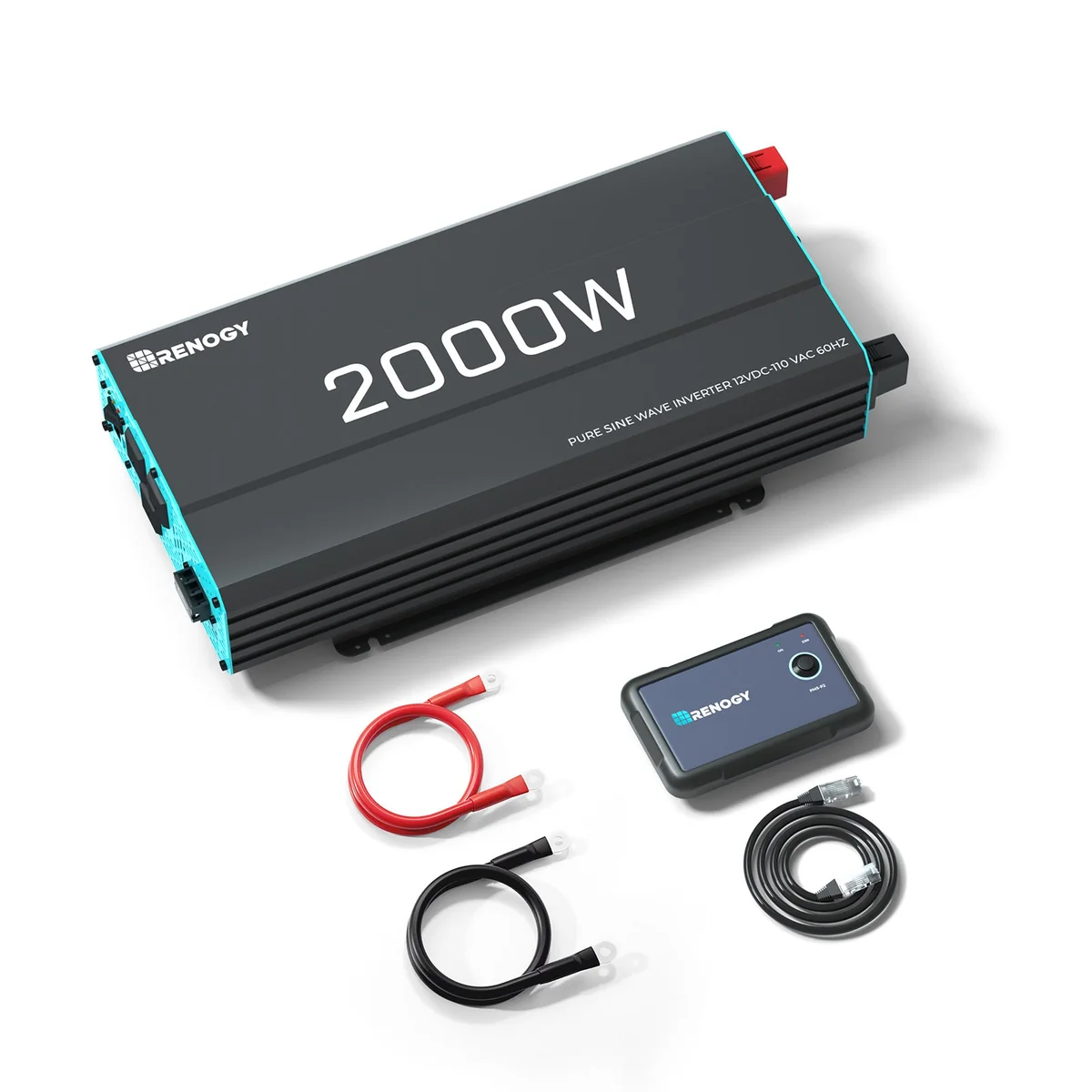
At $285.99 (in stock on Renogy's site), this is a plain 12V-to-120V inverter with 2,000W continuous, 4,000W peak, three AC outlets, a USB port, a hardwire terminal and a wired remote. Renogy lists efficiency above 90%, a 10.0V low-battery shutdown, ETL listing to UL 458, and includes two 3 ft 1/0 AWG cables. Warranty is 1 year.
Pick it if solar (or a vehicle) is your only charging source and your loads stay under about 1,600W continuous with some headroom. Skip it if you have a generator, because it can't charge the battery from AC.
Renogy REGO 3000W 12V Inverter Charger: most surge on 12V
$989.99 for the inverter alone ($1,139.99 with a 5 ft 4/0 AWG cable). Renogy lists 3,000W continuous and 9,000W surge, a 5–75A adjustable charger, a 30A automatic transfer switch with about 10 ms transfer time, and Bluetooth monitoring through Renogy's app. It's UL 458 and CSA listed, with a 2-year warranty.
It's a heavy, low-frequency style unit: 63.5 lb. That weight is part of why it handles big motor starts. The trade-off is idle draw, listed at under 30W, or under 15W in power-saving mode. On a 12V system Renogy says you need at least three 100Ah lithium batteries (or two 170Ah) to run it.
One note: Renogy also sells a newer high-frequency REGO 3000W split-phase-input model at $1,797.99, but it showed as backordered today.
Victron MultiPlus-II 12/3000/120-50: the efficient 12V standard
$999.60 at Backwoods Solar (listed as low inventory). Victron's datasheet rates it at 3,000VA, which is 2,400W continuous at 77°F, 2,200W at 104°F and 5,500W peak. That VA-versus-watts gap matters: a "3,000" Victron is a 2,400-watt inverter.
Where it wins is efficiency and the system around it: 93% max efficiency, 13W idle (3W in search mode), a 120A charger, a 50A transfer switch, and PowerAssist, which tops up a small generator or shore connection with battery power so it doesn't trip. It links to Victron's GX devices and free VRM remote monitoring, and up to six units can run in parallel. Backwoods lists it as UL 458.
Victron MultiPlus-II 48/3000/35-50: low idle draw on 48V
$1,052.30 at Backwoods Solar, listed as UL 1741. Same 2,400W continuous and 5,500W peak as the 12V model, but on 48V it hits 95% efficiency and the lowest idle draw here: 11W, or 2W in search mode. The charger is only 35A on 48V.
This is the pick for a 48V cabin that wants to sip power, or for building a modular system: add a Victron solar charge controller for panels, and pair two units for 240V split phase later. You'll pay more in total than an all-in-one once you add controllers, but each part can be replaced on its own.
EG4 6000XP: best value all-in-one for off-grid homes
$1,499.99 at Signature Solar (list $1,629.99; ShopSolar lists the same price). EG4's spec sheet gives 6,000W continuous at 120/240V split phase, surge of 12,000W for about 3.5 seconds, two MPPTs taking up to 8,000W of panels at up to 480VDC, a 125A battery charger, a 50A grid or generator bypass and Wi-Fi monitoring. Up to 16 units can run in parallel. It carries a 5-year warranty and a UL 1741 certificate.
For an off-grid house this replaces an inverter, two charge controllers and a battery charger with one box at a price close to a single Victron inverter. The costs: about 50W idle draw on battery (roughly 1.2 kWh a day), 93% battery charge and discharge efficiency, and EG4 recommends at least 200Ah of 48V battery per inverter. It's an off-grid unit, so it won't export power to the grid.
EG4 18kPV: hybrid for big homes or a future grid tie
$3,999.99 at Signature Solar (list $4,898; refurbished $3,600). EG4's spec sheet lists 12,000W continuous at 120/240V, three MPPTs using up to 18,000W of panels (21,000W recommended max) at up to 600VDC, 250A battery charge and discharge, and a 200A grid bypass. It's rated NEMA 4X/IP65 for outdoor mounting, and up to 10 can run in parallel.
Unlike the 6000XP, it can run off-grid, use the grid as backup, or sell surplus solar back. CEC efficiency is 96.9%. Idle draw is about 70W in normal mode (18W standby), and EG4 recommends at least 300Ah of 48V battery per inverter, so this only makes sense for large systems with large loads.
Which one should you buy?
| Your setup | Our pick |
|---|---|
| Van or shed, solar-only charging, small loads | Renogy 2000W 12V |
| RV or 12V cabin with a generator, motor loads | Renogy REGO 3000W |
| RV or 12V cabin, efficiency and monitoring matter | Victron MultiPlus-II 12/3000 |
| 48V cabin with modest loads, low idle draw | Victron MultiPlus-II 48/3000 plus a charge controller |
| Off-grid house, 240V well pump, budget matters | EG4 6000XP |
| Large home, or might connect to the grid later | EG4 18kPV |
If you'd rather buy a matched system than pick parts, our off-grid solar kits comparison covers complete kits built around inverters like these, and the cabin solar guide works through a smaller build.
Install notes
- Fuse the battery cable close to the battery, sized for the inverter's maximum DC current, and use the cable size the maker specifies.
- 48V all-in-ones need high-voltage panel strings. The EG4 6000XP's MPPTs work from 100 to 480VDC, so panels are wired in long series strings. Check panel open-circuit voltage at your coldest temperature so you don't exceed the limit.
- Grid-connected and whole-house installs need a permit, and grid export needs utility approval. Have a licensed electrician do the AC side.
- Settings matter. Battery type, charge voltages and low-voltage cutoff need to match your battery's spec sheet, especially for lithium.
Sources
All prices, stock status and specs checked November 11, 2026.
- Renogy, 2000W 12V Pure Sine Wave Inverter product page and specifications
- Renogy, REGO 12V 3000W Pure Sine Wave Inverter Charger product page and specifications
- Renogy, REGO 3000W 12V HF Inverter Charger, Split-phase Design product page
- Renogy, 3000W Inverter Charger product document (battery bank minimums and cable recommendation)
- Victron Energy, MultiPlus-II 120V datasheet
- Backwoods Solar, MultiPlus-II 12/3000/120-50 120V and MultiPlus-II 48/3000 product pages
- Signature Solar, EG4 6000XP Off-Grid Inverter and EG4 18kPV Hybrid Inverter product pages
- EG4 Electronics, 6000XP spec sheet and 18kPV spec sheet
- ShopSolar, EG4 6000XP product page