
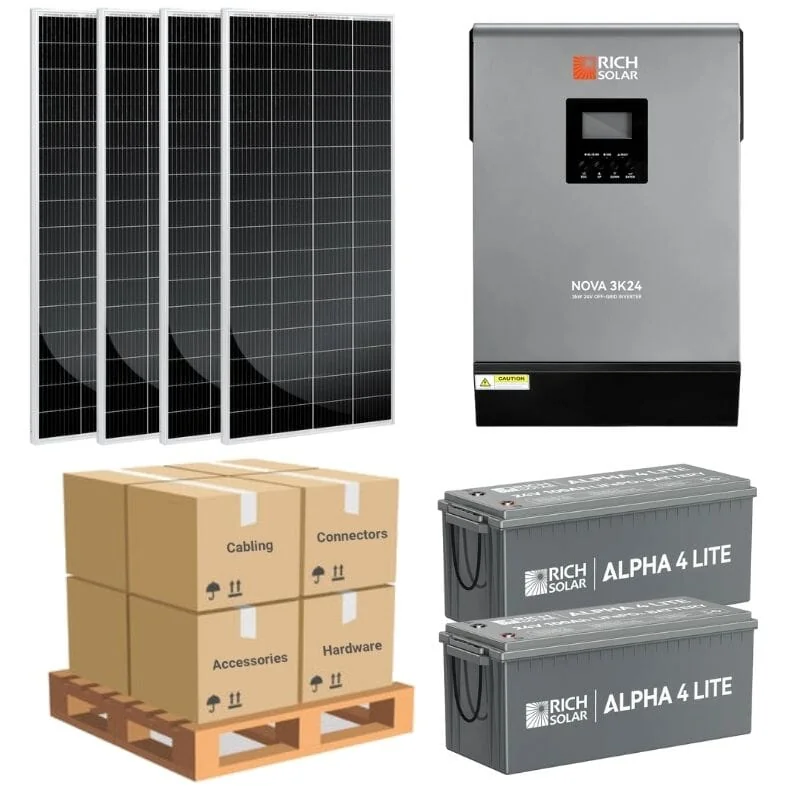
A cabin is the easiest place to start with off-grid solar, because the loads are small: a fridge, some lights, a laptop, maybe a pump. The hard part is not the equipment. It's that winter sun, not summer sun, decides how big the array has to be, and a cabin you only visit in July is a very different build from one you heat and cook in all January.
This guide shows how to size a cabin system with real numbers, then compares six cabin-sized kits from Renogy and ShopSolar using each seller's own page. Prices and stock were checked on November 9, 2026. Seller pages stay as the source for those figures.
Short answer
- Smallest real cabin kit: ShopSolar CORE PLUS 800W at $2,549 — four 200W panels, a 3,000W 24V hybrid inverter and 5.12 kWh of lithium. Enough for lights, a small fridge and electronics. Both battery options showed out of stock today.
- Best value for a cabin you use year-round: ShopSolar CORE PRO 3.2kW at $5,989 — 3.2 kW of panels, a 6,000W split-phase (120/240V) inverter and 10 kWh of battery. It was the only kit here with 240V output and showed in stock.
- Simple 120V kit from a big brand: Renogy 1.2kW Cabin Solution at $4,999.99, with 10.24 kWh of lithium. A larger Renogy 2.5kW is $8,449.99.
- Rule of thumb from the numbers below: a lean cabin that uses about 2.7 kWh a day needs roughly 1.6 kW of panels to cover a Denver winter, and roughly three times that in Montana.
What to use: For the design math behind a cabin array and battery bank, see Solar Electricity Handbook in our Regenerative Library.
Step 1: Add up what the cabin will run
Daily energy is watts × hours per day. Here is a lean cabin, using the approximate wattages and average daily hours from FirstEnergy's appliance fact sheet (the same starting values as our off-grid solar calculator):
| Load | Watts | Hours a day | Watt-hours a day |
|---|---|---|---|
| Refrigerator | 225 | 9.6 | 2,160 |
| 4 LED bulbs (13W each) | 52 | 4 | 208 |
| Laptop, 15 inch | 60 | 2 | 120 |
| Coffee maker | 1,000 | 0.17 | 170 |
| Total | 2,658 Wh (about 2.7 kWh) |
Two notes. The refrigerator is most of the load, so an efficient one is the best money you can spend. And the coffee maker, a microwave or a space heater need a big inverter for a few minutes, but barely move the daily energy total. Heating is the opposite: the same fact sheet lists a portable space heater at about 1,320W, and a few hours of it adds more than the whole table above. Use propane or wood for heat; see Wood Stove vs Rocket Mass Heater for the trade-offs.
A well pump, a washer or a TV adds more. Our solar well pump sizing guide covers pumps in detail.
Step 2: Find your sun hours, especially in winter
Peak sun hours are the number of hours a day your panels receive the equivalent of full midday sun. We use NASA POWER's 2001–2025 averages for flat ground, which lean conservative because tilted panels collect more in winter. Daily energy from an array is array kW × sun hours × 0.75, where 0.75 allows 25% for wiring, heat, dirt and charging losses.
| Array | Denver, CO (yearly / Dec) | Nashville, TN | Helena, MT | Montpelier, VT |
|---|---|---|---|---|
| 0.8 kW (CORE PLUS) | 2.9 / 1.4 kWh a day | 2.5 / 1.2 | 2.4 / 0.7 | 2.1 / 0.6 |
| 1.28 kW (Renogy 1.2kW) | 4.7 / 2.2 | 4.1 / 1.8 | 3.8 / 1.1 | 3.3 / 1.0 |
| 1.6 kW (CORE MAX) | 5.8 / 2.7 | 5.1 / 2.3 | 4.8 / 1.4 | 4.2 / 1.3 |
| 3.2 kW (CORE PRO) | 11.6 / 5.5 | 10.2 / 4.6 | 9.6 / 2.8 | 8.3 / 2.5 |
Yearly sun hours are 4.85 for Denver, 4.23 for Nashville, 4.01 for Helena and 3.47 for Montpelier. The December values are 2.29, 1.92, 1.17 and 1.06. The worst month in Helena has about a quarter of the yearly average, which is why northern cabins need so much more array than a yearly average suggests.
Reading the table against our 2.7 kWh a day cabin:
- Denver, year-round: the 1.6 kW kit just covers it in December (2.7 kWh). The 0.8 kW kit gets about half.
- Helena or Montpelier, year-round: even 1.6 kW makes only 1.3–1.4 kWh in December, about half the load. You need the 3.2 kW array, or a generator for the dark weeks.
- Summer-only cabin: the 0.8 kW kit makes 2.4–2.9 kWh on a yearly-average day in these cities, which is close to the load. Summer months are better than the average.
Step 3: Size the battery and inverter
Battery: daily kWh × days of backup ÷ usable fraction. For 2.7 kWh, two days without sun and 80% usable, that's about 6.6 kWh. Lithium iron phosphate (LiFePO4) batteries are commonly used to 80% or more. The kits below give 5.12 to 20.48 kWh. Most LiFePO4 batteries also shouldn't be charged below freezing, so keep them in a heated space or buy self-heating ones. See our LiFePO4 battery guide.
Inverter: add the running watts of everything that may run at once, then leave headroom for motor start-up. In our cabin, the fridge and coffee maker together draw about 1,225W, so a 3,000W inverter is plenty. A deep well pump or a 240V mini-split needs a split-phase inverter, like the one in the CORE PRO.
Six cabin kits compared
| Kit | Price (Nov 9, 2026) | Array | Battery | Inverter | 240V? |
|---|---|---|---|---|---|
| ShopSolar CORE PLUS 800W | $2,549 (5.12 kWh) / $3,089 (7.68 kWh) | 4 × 200W = 800W | 2 or 3 × 100Ah 24V LFP | 3,000W 24V hybrid | No |
| ShopSolar CORE MAX 1.6kW | $4,389 (5.12 kWh) / $4,989 (7.68 kWh) | 8 × 200W = 1.6 kW | 2 or 3 × 100Ah 24V LFP | 2 × 3,000W 24V hybrid | No |
| ShopSolar CORE PRO 3.2kW | $5,989 | 8 × 400W = 3.2 kW | 2 × 48V 100Ah server-rack LiFePO4 = 10 kWh | 6,000W 48V split-phase hybrid | Yes |
| Renogy 1.2kW Cabin Solution | from $4,999.99 | 1,280W | 10.24 kWh lithium | 3,500W 48V | No |
| Renogy 2.5kW Cabin Solution | $8,449.99 | 2,560W | 20.48 kWh lithium | 3,500W 48V | No |
| Signature Solar EG4 6000XP + Indoor WallMount bundle | $4,208.57 (list $5,094.11) | None; you add panels | EG4 indoor WallMount battery | EG4 6000XP | Yes |
ShopSolar's CORE prices were marked as an early Black Friday sale, with the higher "was" prices at $3,539 (CORE PLUS 5.12 kWh), $5,979 (CORE MAX 5.12 kWh) and $8,549 (CORE PRO). At the time of checking, all four CORE PLUS and CORE MAX battery options were listed as out of stock. Renogy also lists a smaller 400W kit with 2.4 kWh of batteries from $1,899.99 for a shed-sized load. Sale prices change often.
What's in the box
- CORE PLUS and CORE MAX list the panels, the hybrid inverter or inverters, the batteries, a wiring diagram and commissioning guide, pre-cut cables, fuses and circuit protection, a busbar, and mounting hardware and racking. ShopSolar says most customers do most of the install themselves and have an electrician make the final connections.
- CORE PRO lists eight 400W panels, the 6,000W inverter (with 7,500W of solar input), two 48V 100Ah server-rack batteries (10 kWh total) with a 6-slot rack, pre-cut PV extension cables and fuses and circuit protection. Its page doesn't list racking for the panels, so budget for it.
- Renogy Cabin Solutions list the panels, combiner box, breakers, cables, inverter/charger and batteries, but no mounting hardware.
- Signature Solar's bundle is a power core, not a full kit. You still need panels, racking, wiring and protection.
None of these include the cabin's AC wiring, panel, conduit, permits or labor. Ask your county what it requires before you order.
Which cabin kit fits your build
- Weekend or summer cabin, lights and a small fridge: CORE PLUS 800W, if you can get it in stock. Or Renogy's 400W kit for a shed-sized load.
- Cabin you use most of the year in the sunny half of the US: CORE MAX 1.6kW or Renogy 1.2kW cover the lean load in our table, with 120V only.
- Cabin with a well pump, mini-split or a workshop: CORE PRO, or the Signature Solar 6000XP bundle plus panels you pick, because both give 240V.
- Cold, cloudy winters: size the array for December, add a propane or wood backup, and consider a generator input. Every inverter here can charge from a generator.
Mistakes to avoid
- Sizing from summer sun. Use your worst month, or plan a generator.
- Buying 120V when you need 240V. Check the pump and appliance labels first.
- Putting batteries in an unheated shed. Check the charge temperature range on the battery spec sheet.
- Ignoring panel racking. Some kits include it, some don't.
- Skipping the electrician. Even a DIY kit needs the final connections done safely and to code.
Prices and stock change quickly, so confirm the exact configuration on the seller's page the day you order. To run your own numbers, use the off-grid solar calculator. For bigger systems, see Off-Grid Solar Kits: Complete Systems Compared.
Sources
- ShopSolar: CORE PLUS 800W, CORE MAX 1.6kW, CORE PRO 3.2kW: prices, stock, included parts, inverter and battery specs. Checked November 9, 2026.
- Renogy: 1.2kW Cabin Solution, 2.5kW Cabin Solution, and the 400W off-grid kit listing: prices and headline specs. Checked November 9, 2026. Inverter details are from our November 8, 2026 check of the same pages.
- Signature Solar: Off-Grid Solar Kits listing and EG4 6000XP + Indoor WallMount bundle (BNDL-E0009): price. Checked November 9, 2026.
- FirstEnergy: Understanding Electricity Usage & Costs: approximate appliance watts and hours.
- NASA POWER all-sky surface irradiance, 2001–2025 climatology for state capitals, as used in our off-grid solar calculator (pulled November 3, 2026).
- Virginia Cooperative Extension: Estimating Appliance and Home Electronic Energy Use (BSE-301).