
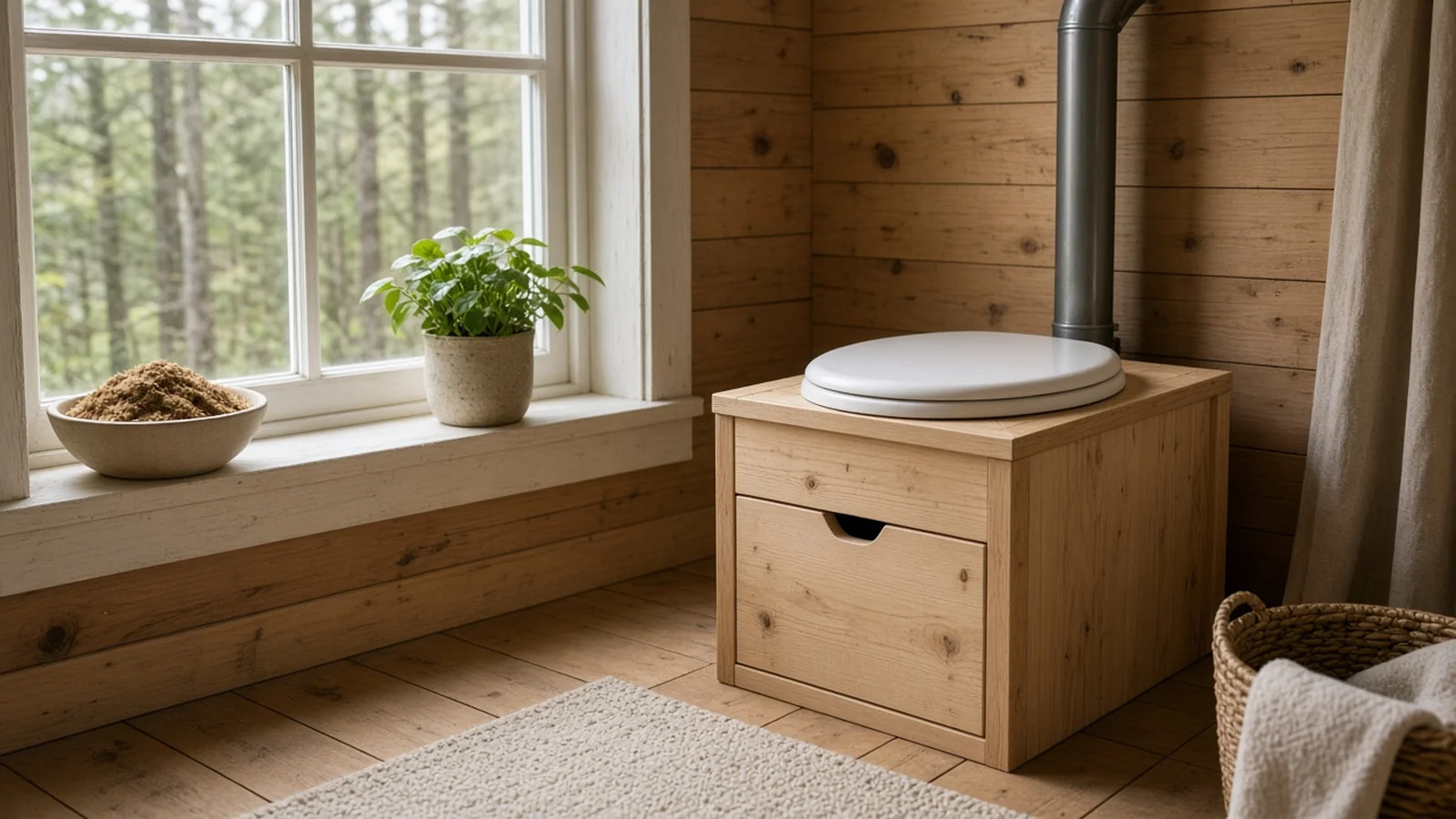
A flush toilet is one of the biggest water users in a home, and it needs a septic system or sewer to work. Off the grid, that can mean a big excavation, a large leach field, or a site that simply can't pass a perc test. A composting toilet skips the water and handles waste where it lands.
This guide uses the U.S. EPA's technical fact sheet on composting toilets as its backbone, so you can compare systems on how they actually work rather than on marketing.
How a composting toilet works
The EPA describes a composting toilet as a well-ventilated container that keeps waste moist but not saturated, so aerobic bacteria and fungi can break it down, much like a yard compost pile. The system holds excrement, toilet paper and a carbon additive such as sawdust or coco coir, and sometimes food scraps.
Sized and maintained properly, it reduces waste to 10% to 30% of its original volume. The end product is a soil-like "humus." The EPA notes that, legally, this material must be buried or removed by a licensed septage hauler according to state and local rules. Check yours before you plan to use it in the garden.
Every system has the same core parts, according to the EPA:
- a composting chamber connected to a dry or micro-flush toilet,
- a screened air inlet and an exhaust vent, often fan-forced, to carry off odor, heat and moisture,
- a way to drain or manage excess liquid, and
- an access door for removing the finished material.
The two big choices
1. Self-contained or central (split) system
- Self-contained units sit on the bathroom floor, with the toilet and composting chamber in one appliance. They're the easiest fit for a cabin, tiny house or RV.
- Central systems put a large composting tank below the floor, often in a basement or crawlspace, with the toilet seat above. The EPA notes some need a basement to install. They take more planning but hold far more and suit a full-time household.
2. Continuous or batch composting
- Continuous systems are a single chamber: waste goes in the top and finished material comes out the bottom.
- Batch systems use two or more chambers. You fill one, then let it cure while you use the next, so finished material isn't mixed with fresh waste. The EPA says nearly all site-built composters worldwide are batch systems, and alternating double bins are the most common type.
What they do well, and where they fall short
From the EPA's list of advantages and disadvantages:
| Pros | Cons |
|---|---|
| No flushing water, so household water use drops | Need more commitment from owners than a septic system |
| In many states, can allow a smaller leach field | Most still need a graywater system for sinks and showers |
| Low power use | Most systems need some power, usually for a vent fan |
| Can accept kitchen scraps | Smaller units can be overwhelmed by peak loads, like a houseful of guests |
| Keep nutrients out of groundwater and streams | Too much liquid can stall the process if it isn't drained |
| Poor installation or upkeep causes odors and unfinished material |
Two of those points matter most for off-grid buyers. First, a composting toilet handles only the toilet. Your shower, sink and laundry water still need somewhere to go, so plan a graywater system alongside it. Second, the vent fan is a small but constant load. Add it to your solar sizing calculator so it runs through winter.
Questions to ask before you buy
- Is it legal where I'm building? Composting toilets are regulated by state and county health departments. Some areas still require a septic system anyway. Call before you buy.
- Is it certified? Many health departments look for certification to NSF/ANSI Standard 41, the standard for composting toilets and similar systems. Ask the seller for the certification listing.
- How many people, and how often? Match capacity to full-time residents, plus a margin for guests. Weekend-cabin use and a family of four are very different loads.
- Does it separate urine? Too much liquid is the most common cause of trouble, so many self-contained units divert urine. Know where that liquid will go.
- How will the vent run? Plan the vent path through the roof or wall, and check the fan's power draw.
- What's the emptying routine? Ask how often the chamber needs emptying at your usage, and where the material will cure.
- What will I do with the finished material? The EPA warns that using under-treated compost as a soil amendment can carry health risks. Many owners use it only around trees and non-food plants.
What to read before you buy
These two books in our Regenerative Library are the deepest references on the subject:
- The Composting Toilet System Book by David Del Porto and Carol Steinfeld, a practical guide to choosing, planning and maintaining a composting toilet system matched to your site.
- The Humanure Handbook by Joseph C. Jenkins, the classic on composting human manure safely, with guidance on simple dry toilets.
For planning steps and expert videos, see the Waste hub.
Sources
- U.S. Environmental Protection Agency. Water Efficiency Technology Fact Sheet: Composting Toilets. EPA 832-F-99-066, September 1999. epa.gov (PDF)
- U.S. Environmental Protection Agency. "Water Efficiency Technology Fact Sheets." epa.gov