
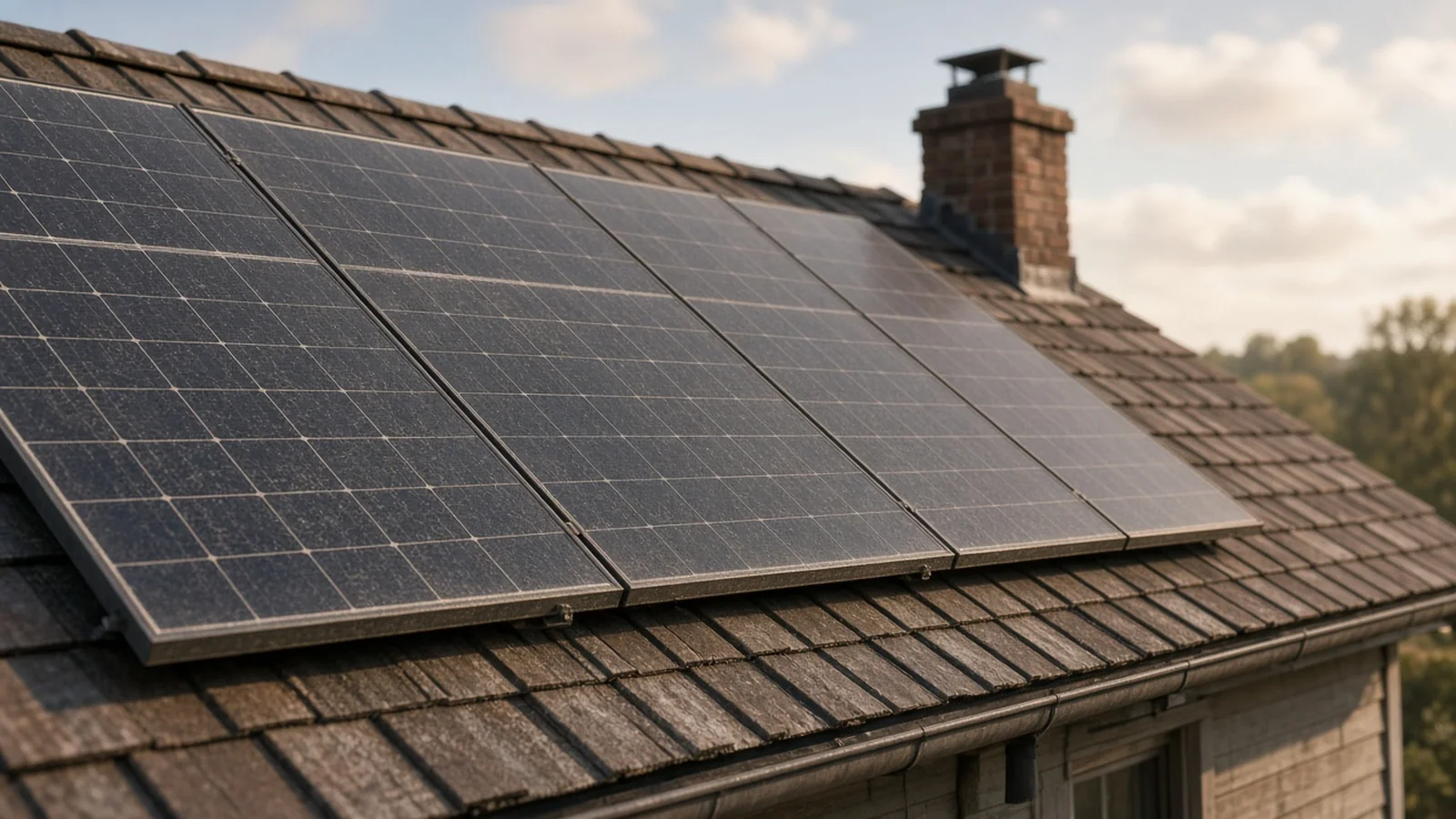
A 400 watt solar panel is the sweet spot for a lot of off-grid builds. It's big enough that a cabin, shed or tiny home only needs a handful of them, but still light enough (about 45 lbs for a rigid one) for two people to carry onto a roof or a ground rack.
Shopping for one is harder than it should be. Some "400W" listings are really two 200W panels in a box. Some are folding panels made for portable power stations. And many good rigid 400W panels are only sold in packs or by the pallet.
This guide explains what one 400W panel actually produces, what you'll pay once shipping is added, and how to wire it. Then it compares six real 400W options, using prices and specs from each seller's or maker's own page, checked on November 23, 2026. Prices move often, and several of these were sold out that day, so treat each page as the final word.
Short answer
- Best rigid 400W panel you can buy in small numbers: Renogy 400W N-Type Bifacial, sold as a 2-pack for $659.99 (about $330 a panel), plus $250 shipping for the pair. N-type cells, 21.5% module efficiency, 25-year output warranty.
- Best for a bigger array: Rich Solar MEGA 400, $2,699.99 for 8 panels (about $337.50 each). UL 61730 listed, 12-year workmanship warranty. Pallet shipping only.
- Cheapest per watt (when you can get it): ZNShine ZXM7-SH108-400/M at $144.99 ($0.36/W). Sold out at US Solar Supplier on November 23; another dealer had it in stock but with a 10-panel minimum.
- Best 400W folding panel: Anker SOLIX PS400 Bifacial, $799.99 list, 21.9 lbs. Anker said new orders ship in early December.
- Also worth watching: EcoFlow 400W Lightweight Portable, $699, sold out when checked.
- 400 watts in two smaller panels: Renogy 200W N-Type Bifacial, $392.99 for two (400W total). Easier to fit on an RV or van roof.
What to use: If you want 400 watts on a roof that can't fit a 5.6 ft panel, the Renogy 400W bifacial set (two 200W panels) on Amazon is the easy route. Each panel is 51.7 x 30.1 in and 22.7 lbs, so it fits RVs, vans and small sheds. Note that this listing is two 200W panels, not one 400W panel. Amazon's price can differ from Renogy's.
What "400 watt" actually means
The 400W rating is measured under Standard Test Conditions (STC): 1,000 watts of sunlight per square meter, a cell temperature of 25°C (77°F), and an air mass of 1.5. Renogy prints exactly these conditions at the bottom of its datasheet. Real roofs rarely match them. Panels get hot, the sun is at an angle, and some energy is lost in wiring and charging.
So a 400W panel usually makes less than 400W, even at noon. That's normal. You should plan around the panel's daily energy (watt-hours), not its peak watts.
Most rigid 400W panels sold in the US today share one basic design: 108 half-cut monocrystalline cells, about 67.8 x 44.7 inches (roughly 21 square feet), and about 45 lbs. The Renogy, Rich Solar and ZNShine panels below all fit that description. Their open-circuit voltage (Voc) is around 37 to 39V, which works well with common 100V and 150V MPPT charge controllers.
Older or residential 400W panels can be very different. A 132-cell Panasonic EverVolt 400W panel listed by US Solar Supplier, for example, has a Voc of 48.8V. Always check the Voc before you choose a controller.
How much power does a 400W panel make per day?
A simple planning formula:
Daily watt-hours ≈ 400 W × peak sun hours × 0.75
Peak sun hours come from NASA POWER, a NASA dataset of long-term solar resource values. The 0.75 is our planning assumption, not a measured value: NREL's PVWatts calculator starts with about 14% default system losses (wiring, dirt, mismatch and more), and in off-grid systems you also lose some energy to heat and battery charging. If you want a tighter number for your exact address, run it through PVWatts.
Here's what one 400W panel works out to with that formula, using NASA POWER data for state capitals (flat ground, 2001–2025 averages):
| Location | Avg sun hours | Wh/day (average) | Worst month sun hours | Wh/day (worst month) |
|---|---|---|---|---|
| Phoenix, AZ | 5.85 | ~1,755 | 3.08 | ~924 |
| Austin, TX | 4.81 | ~1,443 | 2.74 | ~822 |
| Denver, CO | 4.85 | ~1,455 | 2.29 | ~687 |
| Raleigh, NC | 4.47 | ~1,341 | 2.31 | ~693 |
| Nashville, TN | 4.23 | ~1,269 | 1.92 | ~576 |
| Boise, ID | 4.56 | ~1,368 | 1.39 | ~417 |
| Montpelier, VT | 3.47 | ~1,041 | 1.06 | ~318 |
| Olympia, WA | 3.42 | ~1,026 | 0.85 | ~255 |
Two things stand out. First, a single 400W panel makes roughly 1 to 1.8 kWh on an average day in most of the lower 48. That's enough to run an efficient 12V fridge, lights, a router and phone charging. Second, winter is a very different story. In Boise, Vermont or western Washington, the worst month can drop below a third of the yearly average. If you need power year-round, size for your worst month, not the average.
Our flat-ground numbers are conservative. Tilting a panel toward the sun, especially in winter, can raise output.
To size a whole system, use the Off-Grid Solar Calculator. It uses the same NASA POWER data for all 50 state capitals.
400W panels compared
All prices and specs from each seller's or maker's own page, November 23, 2026.
| Panel | Type | Price | Per watt | Voc | Size | Weight | Warranty | Stock (Nov 23) |
|---|---|---|---|---|---|---|---|---|
| Renogy 400W N-Type Bifacial (RSP400DCT-108) | Rigid, bifacial | $659.99 / 2 | $0.82 | 39.42V | 67.8 x 44.7 x 1.4 in | 45.42 lbs | 25-yr output, 10-yr materials | Listed for sale |
| Rich Solar MEGA 400 (RS-M400) | Rigid | $2,699.99 / 8 | $0.84 | 37.1V | 67.8 x 44.7 x 1.2 in | 45.2 lbs | 25-yr output, 12-yr workmanship | Pallet only |
| ZNShine ZXM7-SH108-400/M | Rigid, all black | $144.99 | $0.36 | n/a on seller page | 67.80 x 44.65 x 1.18 in | 45.19 lbs | 25-yr linear power, 12-yr product | Sold out at US Solar Supplier |
| Anker SOLIX PS400 Bifacial | Folding | $799.99 | $2.00 | 57.6V* | 22.3 x 38.7 x 3.2 in folded | 21.9 lbs | 5-yr | Ships early December |
| EcoFlow 400W Lightweight Portable | Folding, bifacial | $699 | $1.75 | not listed | not listed | not listed | not listed | Sold out |
| Renogy 200W N-Type Bifacial x2 | 2 rigid panels | $392.99 / 2 | $0.98 | 29.6V each | 51.7 x 30.1 x 1.2 in each | 22.71 lbs each | 25-yr output, 10-yr materials | Listed for sale |
*Anker's US page lists 48V and 8.33A output but not Voc. The 57.6V figure is from a US retailer's spec sheet for the same panel (Earthtech Products).
Per-watt figures are our own math: price ÷ total rated watts, before shipping and tax.
The picks in detail
Renogy 400W N-Type Bifacial: best rigid panel in small quantities
Renogy sells this panel in packs of 2, 4, 6 or 10. The 2-pack is $659.99, and the 10-pack is $3,035.99 (about $304 a panel). Renogy charges separately for freight on these: $250 for 2 panels, $300 for 4, $400 for 6 and $500 for 10. So a 2-pack delivered is about $910, or roughly $1.14 per watt. Buying four or more brings the shipping per panel down a lot.
From Renogy's datasheet: 400W at STC, Vmp 34.0V, Imp 11.76A, Voc 39.42V, Isc 13.06A, 21.5% module efficiency, 108 N-type cells, 3.2mm tempered glass, IP68 junction box, and a temperature coefficient of -0.32%/°C. That last number is better than typical older P-type panels, which matters in hot climates.
It's also bifacial. Renogy claims up to 30% more energy when the back side can see reflected light, such as snow, sand or a light-colored surface. That gain depends heavily on how high and how steep you mount it. On a flush roof mount, expect little or no rear-side gain. On a raised ground rack over gravel or snow, the back side helps more.
Good for: cabins, sheds and ground mounts where you want a small number of high-output panels.
Rich Solar MEGA 400: best for a full array
Rich Solar sells the MEGA 400 by the pallet only: 8 panels for $2,699.99, 10 for $3,299.99, 12 for $3,899.99 or 36 for $12,099.99. For anyone building a 3 kW or larger off-grid system, that works out to about $325 to $338 a panel.
Specs from Rich Solar: Vmp 31.0V, Imp 12.9A, Voc 37.1V, Isc 13.7A, 1,500VDC maximum system voltage, up to 23.2% cell efficiency, a 0 to +5W power tolerance (so it shouldn't test under 400W at STC), and ratings of 5,400 Pa snow load and 2,400 Pa wind load. It carries UL 61730, IEC 61215 and CSA certifications, which matter if your county inspects off-grid systems. Rich Solar calls it a "24V" panel, but like every panel here, it needs an MPPT controller to charge any battery properly.
Good for: whole-home off-grid systems and anyone who needs UL-listed panels for permitting.
ZNShine ZXM7-SH108-400/M: cheapest per watt
At $144.99 ($0.36/W), this all-black PERC panel is less than half the price per watt of the branded options. US Solar Supplier lists it at 67.80 x 44.65 x 1.18 in, 45.19 lbs, up to 20.03% module efficiency, a 12-year product warranty and a 25-year linear power warranty.
The catch is availability. On November 23 it showed as sold out at US Solar Supplier. Another dealer, PES Supply, listed it at the same $144.99 and in stock, but with a 10-panel minimum and freight added at checkout. Panels this cheap usually come from installer-focused suppliers, so expect freight shipping and less hand-holding.
Good for: budget builds of 10 panels or more, if you can find stock.
Anker SOLIX PS400 Bifacial: best 400W folding panel
If your 400W panel needs to fold up and travel with a portable power station, the PS400 Bifacial is the lightest option here at 21.9 lbs. It folds to 22.3 x 38.7 x 3.2 inches and opens to 90.2 x 38.7 inches. Anker lists a 400W rating, 48V / 8.33A output, IP68 water and dust resistance, and a 5-year warranty. It comes with two 8.2 ft solar cables and an XT-60i cable.
Anker lists it at $799.99 and says orders placed on or after October 30 ship in early December.
Two cautions. Folding panels cost about twice as much per watt as rigid panels. And at roughly 48V operating voltage (57.6V Voc per a retailer's spec sheet), it's above the solar input limit of some smaller power stations. Check your station's maximum input voltage before you buy.
Good for: camping, van life and emergency backup with a portable power station.
EcoFlow 400W Lightweight Portable: watch for a restock
EcoFlow lists its 400W portable panel at $699, but it was sold out on November 23. EcoFlow says it's bifacial with N-type TOPCon cells, rated at 400W (445W under its BNPI rear-light test), 34.5V and 11.7A output, IP68, with a stand that sets to 30°, 45° or 60°. EcoFlow's page didn't list weight or Voc when we checked.
Good for: EcoFlow power station owners, once it's back in stock.
Two Renogy 200W bifacial panels: 400 watts that fit smaller roofs
A 67.8 x 44.7 inch panel won't fit on many RVs, vans or shed roofs. Two 200W panels give you the same 400W in a shape that's easier to place. Renogy sells its 200W N-type bifacial panel at $199.99 each or $392.99 for two. Each panel is 51.7 x 30.1 x 1.2 inches and 22.71 lbs, with a Voc of 29.6V, Isc of 8.7A and 19.9% module efficiency.
This is also the set in our "What to use" line above. On Amazon, Renogy sells it as a "400W" bundle, but it's two 200W panels.
Good for: RVs, vans, boats and small roofs.
How to wire a 400W panel
You need an MPPT charge controller
A 108-cell 400W panel runs at about 31 to 34V at its maximum power point. A 12V battery charges at about 14V. A cheap PWM controller would pull the panel down to battery voltage and throw away a big share of its power. An MPPT controller converts the extra voltage into extra current, so you keep most of the panel's output.
Rough controller sizing (panel watts ÷ charging voltage, about 14V for a 12V battery or 28V for a 24V battery, then round up to the next common controller size):
- One 400W panel, 12V battery: about 29A → a 40A MPPT
- Two 400W panels, 12V battery: about 57A → a 60A MPPT, or switch to 24V
- Two 400W panels, 24V battery: about 29A → a 40A MPPT
Our charge controller guide covers specific models and how to size them.
Check cold-weather voltage
A panel's voltage goes up when it's cold. Your controller's maximum input voltage has to cover the coldest morning your panels will see.
Using Renogy's datasheet numbers (Voc 39.42V, Voc coefficient -0.26%/°C), here's the math for a -4°F (-20°C) morning: that's 45°C below the 25°C test temperature, so Voc rises by about 11.7%, to roughly 44.0V per panel.
- 2 in series: ~88V. That fits a 100V controller, but without much headroom.
- 3 in series: ~132V. That needs a 150V controller.
If your winters get colder than that, or you're using panels with a higher Voc, redo the math with your own panel's datasheet. If you're not sure, give yourself extra margin and pick a 150V controller.
Series or parallel?
Series wiring adds voltage and keeps current the same, so you can use thinner wire over long runs. Parallel wiring adds current and keeps voltage the same, which helps when one panel gets shaded but needs heavier wire and often fuses. For a ground-mounted array 50+ feet from the battery, series is usually the better choice.
Before you buy
- Measure your space. A rigid 400W panel is about 5.6 x 3.7 feet. Check the roof, rack or ground area, and leave room for wind clearance and maintenance.
- Price it delivered. Big panels ship by freight. Renogy's $125-per-panel shipping on a 2-pack adds about 38% to the panel price.
- Check the certifications. If your county requires permits for off-grid systems, ask whether panels need a UL 61730 listing. Rich Solar lists it. Renogy's datasheet for this panel lists CE, RCM, TSCA and CA65.
- Read the warranty. Look at both the output warranty (usually 25 years) and the materials or workmanship warranty, which ranges from 5 years (Anker) to 12 years (Rich Solar, ZNShine) here.
- Plan the rest of the system. Panels alone don't power anything off-grid. You also need a charge controller, a battery bank and usually an inverter. See Off-Grid Solar Kits Compared if you'd rather buy everything together.
Panels also lose output slowly over time. Our summary of NREL's field tests on solar panel degradation shows most panels lose about 0.2% to 0.5% a year.
Sources
- Renogy, 400W N-Type Bifacial Solar Panel product page and RSP400DCT-108x2 datasheet: https://www.renogy.com/products/400w-n-type-bifacial-solar-panel (checked Nov 23, 2026)
- Renogy, 100/200W N-Type Bifacial Solar Panel product page: https://www.renogy.com/products/100-200w-n-type-bifacial-solar-panel (checked Nov 23, 2026)
- Rich Solar, MEGA 400 product page: https://richsolar.com/products/mega-400-400-watt-24-volt-solar-panel (checked Nov 23, 2026)
- US Solar Supplier, ZNShine 400W ZXM7-SH108-400/M listing: https://ussolarsupplier.com/products/znshine-400w-zxm7-sh108-400-m-monocrystalline-solar-panel (checked Nov 23, 2026)
- PES Supply, ZNShine 400W ZXM7-SH108-400/M listing: https://www.portlandiaelectric.supply/products/znshine-400w-zxm7-sh108-400-m-all-black-monocrystalline-solar-panel (checked Nov 23, 2026)
- US Solar Supplier, solar panels collection (Panasonic EverVolt 400W Voc): https://ussolarsupplier.com/collections/solar-panels?page=14 (checked Nov 23, 2026)
- Anker SOLIX, PS400 Bifacial Portable Solar Panel: https://www.ankersolix.com/products/ps400-bifacial-portable-solar-panel (checked Nov 23, 2026)
- Earthtech Products, Anker SOLIX PS400 Bifacial specifications (Voc): https://www.earthtechproducts.com/anker-solar-panel-ps400-bifacial.html (checked Nov 23, 2026)
- EcoFlow, 400W Lightweight Portable Solar Panel: https://us.ecoflow.com/products/400w-portable-solar-panel (checked Nov 23, 2026)
- NASA POWER, all-sky surface irradiance climatology (2001–2025), as used in this site's calculators
- NREL, PVWatts Calculator: https://pvwatts.nrel.gov/