
A charge controller sits between your solar panels and your battery. Its job sounds simple: push as much solar power into the battery as possible, then back off before the battery is overcharged. Pick the wrong one and you either waste a big share of your panels' output or, worse, fry the controller the first cold morning your panels put out more voltage than it can take.
This guide explains MPPT vs PWM in plain terms, shows how to size a controller for both current and voltage, and then compares seven real controllers using each seller's own product page. Prices and specs were checked on November 13, 2026. Seller pages stay the source for those figures, and prices change often.
Short answer
- Tiny 12V system with one panel (shed light, trickle-charging a battery): a PWM controller like the Renogy Wanderer Li 30A at $32.99. Its maximum PV input is only 25V, so it suits a single "12V" panel.
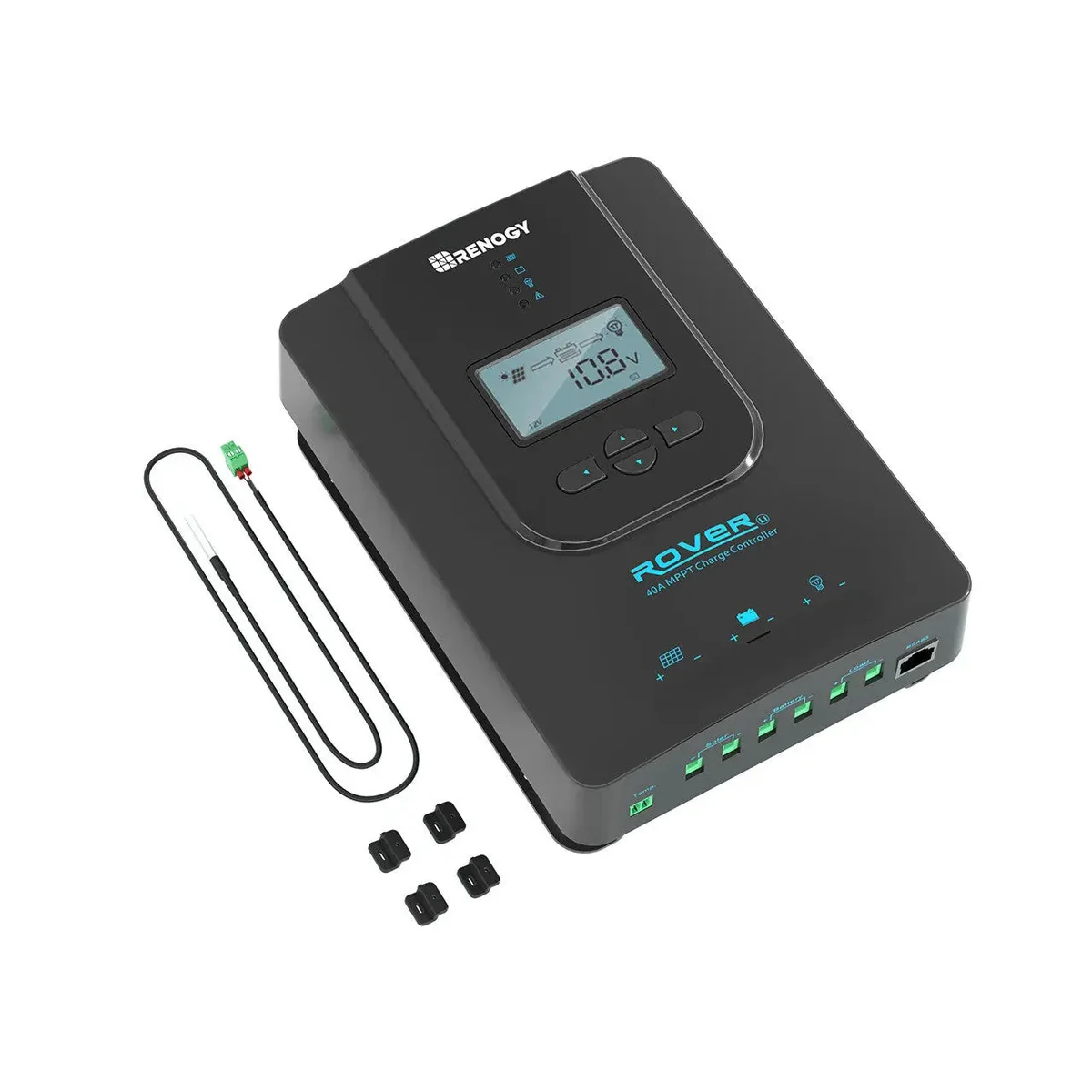
- Budget MPPT for a 12V or 24V van, cabin or shed: the Renogy Rover Li, from $87.99 (20A) to $205.99 (40A), controller only.
- Best all-round small-system MPPT: the Victron SmartSolar MPPT 100/30 at $135.15, with built-in Bluetooth and a five-year warranty. Step up to the 100/50 at $193.80 for more panels.
- 48V homestead or larger cabin: the Victron SmartSolar MPPT 150/60-Tr at $368.90 (up to 3,500W nominal at 48V), or the Renogy Rover Lite 60A at $249.99 if price matters more.
- Big arrays and whole-home off-grid: the Victron SmartSolar MPPT 250/100-Tr VE.Can at $643.45 (up to 5,800W nominal at 48V) or the MidNite Classic 150 at $850.00.
What to use: If you want the design math behind controllers, wiring and the rest of a stand-alone system in one place, Solar Electricity Handbook is in our Regenerative Library.
What a charge controller for solar panels actually does
Solar panels don't put out a steady, battery-friendly voltage. A panel sold as "12V" usually runs at around 18V at its best operating point and higher with no load on it. Connect it straight to a battery and you'd overcharge the battery on sunny days, and let the battery drain back through the panel at night.
A charge controller handles three jobs:
- Regulates charging through bulk, absorption and float stages, using a profile that matches your battery chemistry (lithium iron phosphate, AGM, gel or flooded lead-acid).
- Blocks reverse current so the battery doesn't leak back into the panels after dark.
- Protects the system against reverse polarity, short circuits and overheating. Many also have a "load" output that can switch a light or small DC load off before the battery runs flat.
If your inverter already has solar charge controllers built in (most all-in-one off-grid and hybrid inverters do), you may not need a separate controller at all. See our off-grid inverter guide for how those units work.
MPPT vs PWM: what the difference means in watts
Victron Energy published a clear technical paper on this question, using a typical 100W, 36-cell panel (18V at maximum power, 5.56A, 21.6V open-circuit). Its findings are the best plain explanation we've found:
- A PWM controller is basically a switch. When it's on, it connects the panel straight to the battery, so the panel is dragged down to roughly battery voltage. With a 13V battery and about 0.5V lost in cables and the controller, the panel runs at 13.5V instead of its ideal 18V.
- An MPPT controller is a DC-to-DC converter. It runs the panel at its maximum power point (18V in the example), then converts that power down to battery voltage at a higher current. In Victron's example, 100W at 18V becomes about 7.7A into a 13V battery.
At a panel temperature of 25°C (77°F), Victron calculated that the PWM controller harvested 81W versus 100W for MPPT, which is 19% less. At a very hot cell temperature of 75°C, the gap disappeared: about 77W for both, because a hot panel's voltage drops close to battery voltage anyway.
Victron's conclusion was that MPPT is the better choice when cells are often below 45°C or above 75°C, when higher array voltage lets you use thinner and cheaper cable, when output in low light matters, or when partial shading is a concern. It also notes that both types perform roughly the same in subtropical and tropical climates.
| PWM | MPPT | |
|---|---|---|
| How it works | Switch: panel runs near battery voltage | DC-DC converter: panel runs at its best voltage |
| Panel wiring | Panel voltage must match the battery (a "12V" panel for a 12V battery) | Panels can be wired in series for higher voltage |
| Harvest at 25°C cell temp (Victron example) | 81W from a 100W panel | 100W from a 100W panel |
| Long cable runs | Needs heavy cable (low voltage, high current) | Higher array voltage means lower current and thinner cable |
| Typical price in this guide | $32.99 for 30A | $87.99 for 20A to $850 for large units |
| Best for | One or two small panels, warm climates, tight budgets | Almost everything else |
Our take: for any system larger than a panel or two, buy MPPT. Even the cheapest MPPT in this guide costs less than a single extra 100W panel, and it gets more out of every panel you already own, especially in winter when you need it most.
How to size a solar charge controller
You need to check two numbers, and both matter. Current decides how many panels the controller can use. Voltage decides whether it survives.
Step 1: Pick your battery voltage
Small systems run on 12V, larger cabins on 24V, and most homes on 48V. Higher battery voltage means a given controller can handle more watts. Victron's SmartSolar 150/60, for example, is rated for 750W of nominal PV input on a 12V battery but 3,500W on a 48V battery, according to Backwoods Solar's listing.
If you haven't sized the system yet, run your loads through the off-grid solar calculator and the battery bank calculator first.
Step 2: Check the charge current (amps)
A rough way to check: divide your array's watts by the battery voltage. 400W of panels on a 12V battery works out to about 33A, so a 40A controller is a sensible fit. On a 24V battery, the same 400W is about 17A.
The easier and safer way is to use the maker's own "nominal PV power" rating for your battery voltage, because it already accounts for charging voltage. The Victron SmartSolar 100/30 is listed at 440W on 12V and 880W on 24V. The Renogy Rover Li 40A is listed at 520W on 12V and 1,040W on 24V.
Many MPPT controllers allow you to connect somewhat more panel wattage than the rated figure and simply cap the output current. Check your controller's manual before you oversize the array; not every maker allows it.
Step 3: Check the maximum PV voltage, with cold weather in mind
This is the step people miss. Panel voltage rises as the panel gets colder. Your array's open-circuit voltage (Voc) on a freezing, sunny morning can be well above the number printed on the panel label, and if it goes over the controller's maximum PV input voltage, the controller can be damaged.
To estimate it, use your panel's Voc and its temperature coefficient of Voc from the panel's spec sheet:
Cold Voc = Voc × (1 + (lowest temperature in °C − 25) × Voc coefficient)
Using the panel from Victron's paper (Voc 21.6V, coefficient −0.35%/°C) on a −20°C (−4°F) morning:
21.6 × (1 + (−20 − 25) × −0.0035) = 21.6 × 1.1575 = about 25.0V per panel
Now apply that to real controllers:
- Renogy Wanderer Li 30A (25V max PV input): one panel at about 25.0V sits right at the limit. In a climate that cold, that's too close.
- Victron SmartSolar 100/30 (100V max PV open-circuit voltage): three panels in series reach about 75V, which is safe. Four panels reach about 100V, right at the limit, so don't.
- Victron SmartSolar 150/60-Tr (150V max): five panels in series reach about 125V, which leaves margin.
Use your own panel's numbers and your area's record low, not an average winter day. Victron's free MPPT calculator runs the same check for its controllers.
Step 4: Match the battery chemistry
Most modern controllers have lithium (LiFePO4) charge profiles. If you're building around lithium, confirm the controller has a lithium setting or fully adjustable voltages. Our LiFePO4 battery guide covers the batteries themselves.
The seven picks compared
All prices are from the seller's own product page on November 13, 2026. Renogy prices are for the controller only unless noted.
| Controller | Type | Battery voltage | Max charge current | Max PV voltage | Nominal PV input (seller) | Price |
|---|---|---|---|---|---|---|
| Renogy Wanderer Li 30A | PWM | 12V | 30A | 25V | n/a | $32.99 |
| Renogy Rover Li 20/30/40A | MPPT | 12/24V | 20–40A | 100V (Voc) | 520W @12V, 1,040W @24V (40A) | $87.99–$205.99 |
| Victron SmartSolar 100/30 | MPPT | 12/24V | 30A | 100V (Voc) | 440W @12V, 880W @24V | $135.15 |
| Victron SmartSolar 100/50 | MPPT | 12/24V | 50A | 100V (Voc) | 700W @12V, 1,400W @24V | $193.80 |
| Renogy Rover Lite 60A | MPPT | 12/24/36/48V | 60A | 150V (Voc) | 900W @12V to 3,200W @48V | $249.99 |
| Victron SmartSolar 150/60-Tr | MPPT | 12/24/48V | 60A | 150V (Voc) | 750W @12V, 1,800W @24V, 3,500W @48V | $368.90 |
| Victron SmartSolar 250/100-Tr VE.Can | MPPT | 12/24/48V | 100A | 250V (Voc) | 1,450W @12V, 2,900W @24V, 5,800W @48V | $643.45 |
1. Renogy Wanderer Li 30A PWM: cheapest way to protect a small battery
$32.99 at Renogy. It's a 12V-only, 30A PWM controller with a four-stage charging profile, lithium support and very low self-consumption (under 10mA, per Renogy). The catch is the 25V maximum PV input voltage, which limits you to "12V" panels wired in parallel, never in series. It fits a shed light, a gate opener or a battery maintainer. For anything bigger, the money you save is lost in harvest.
2. Renogy Rover Li 20/30/40A: budget MPPT for 12V and 24V
From $87.99 (20A), $149.99 (30A) and $205.99 (40A) at Renogy, controller only; Bluetooth bundles cost more. Renogy lists a 15–100V solar input range, up to 99% tracking efficiency and 98% peak conversion efficiency, auto-detection of 12V or 24V for non-lithium batteries, and a three-year material and workmanship warranty. The box includes a remote temperature sensor. It's a good match for the kits in our shed solar and cabin solar guides.
3. Victron SmartSolar MPPT 100/30 and 100/50: best small-system controllers
$135.15 (100/30) and $193.80 (100/50) at Backwoods Solar (100/30, 100/50). Both work on 12V or 24V batteries with a 100V maximum open-circuit PV voltage. Backwoods lists Bluetooth built in (no dongle), a VE.Direct port, up to 98% maximum efficiency, UL-1741 certification and a five-year limited warranty. You pay more than for the Rover Li, and you get Victron's app, its wider support network and the ability to link with Victron monitors and inverters later. If your array might grow past about 440W on 12V, buy the 100/50 now.
4. Renogy Rover Lite 60A: budget pick for 48V
$249.99 at Renogy ($261.99 with the Bluetooth module). It covers 12V, 24V, 36V and 48V batteries, takes up to 150V open-circuit from the array, and Renogy rates it for up to 3,200W of solar on a 48V battery. Renogy lists MPPT tracking efficiency above 99% and a two-year warranty. That's the cheapest path to a 48V, 60A MPPT in this guide.
5. Victron SmartSolar MPPT 150/60-Tr: best for a 48V homestead
$368.90 at Backwoods Solar. It auto-selects 12V, 24V or 48V, takes up to 150V open-circuit, and is rated at 3,500W nominal PV input on 48V. The smaller 150/45-Tr is $229.50 if you need up to 2,600W at 48V. For a real house you'll usually run two or more of these, or one larger unit.
6. Victron SmartSolar MPPT 250/100-Tr VE.Can: big arrays on one controller
$643.45 at Backwoods Solar. A 100A controller with a 250V maximum open-circuit voltage, so you can run long series strings and keep wire sizes reasonable on a long run from a ground mount to the house. It's rated at 5,800W nominal PV input on 48V and adds VE.Can networking for systems with several controllers and a Victron GX monitor.
7. MidNite Classic 150: the off-grid veteran's choice
$850.00 at Backwoods Solar. Backwoods notes that the Classic includes ground fault protection, so a separate GFP breaker assembly isn't needed, offers MPPT modes for solar, wind or hydro, has two auxiliary outputs, and stacks without a hub. It comes in 150, 200 and 250V versions and carries a five-year extendable warranty. Backwoods says its own staff run MidNite controllers in their full-time off-grid homes. It's the priciest pick here, and it makes the most sense if you also have a micro-hydro or small wind turbine.
Installation tips that prevent most problems
- Connect the battery first, then the panels. Most makers, including Renogy in its product notes, ask you to set or confirm battery voltage before the PV side goes live.
- Fuse the battery cable. Put a correctly sized fuse or breaker between the controller and the battery, close to the battery, following the controller manual.
- Keep battery cables short and thick. The controller-to-battery run carries the highest current in the solar side of the system.
- Use a battery temperature sensor with lead-acid batteries, and with lithium if the battery sits somewhere that freezes. Lithium batteries must not be charged below freezing unless they have built-in heating.
- Leave room for airflow. Controllers shed heat through their fins and reduce output when they get hot.
- Larger systems need permits. A whole-home off-grid system usually needs an electrical permit and an inspection. Check with your county before you wire it.
Which one should you buy?
- One small panel and a 12V battery: Renogy Wanderer Li 30A.
- 200–500W on 12V or 24V, on a budget: Renogy Rover Li.
- 200–1,400W on 12V or 24V, and you want the best app and support: Victron SmartSolar 100/30 or 100/50.
- A 48V cabin or homestead up to about 3,500W per controller: Victron SmartSolar 150/60-Tr, or the Renogy Rover Lite 60A to save money.
- Long wire runs, big ground-mount arrays or hydro and wind: Victron 250/100-Tr or MidNite Classic 150.
Not sure about your array size yet? Start with the off-grid solar calculator, then come back and match a controller to the result.
Sources
- Victron Energy, Which solar charge controller: PWM or MPPT? (technical paper, January 20, 2020).
- Victron Energy, MPPT calculator.
- Renogy product pages (prices and specs checked November 13, 2026): Wanderer Li 30A PWM, Rover Li 20/30/40A MPPT, Rover Lite 60A MPPT.
- Backwoods Solar product pages (prices and specs checked November 13, 2026): Victron SmartSolar MPPT 100/30, 100/50, 150/45-Tr, 150/60-Tr, 250/100-Tr VE.Can, MidNite Classic 150.