
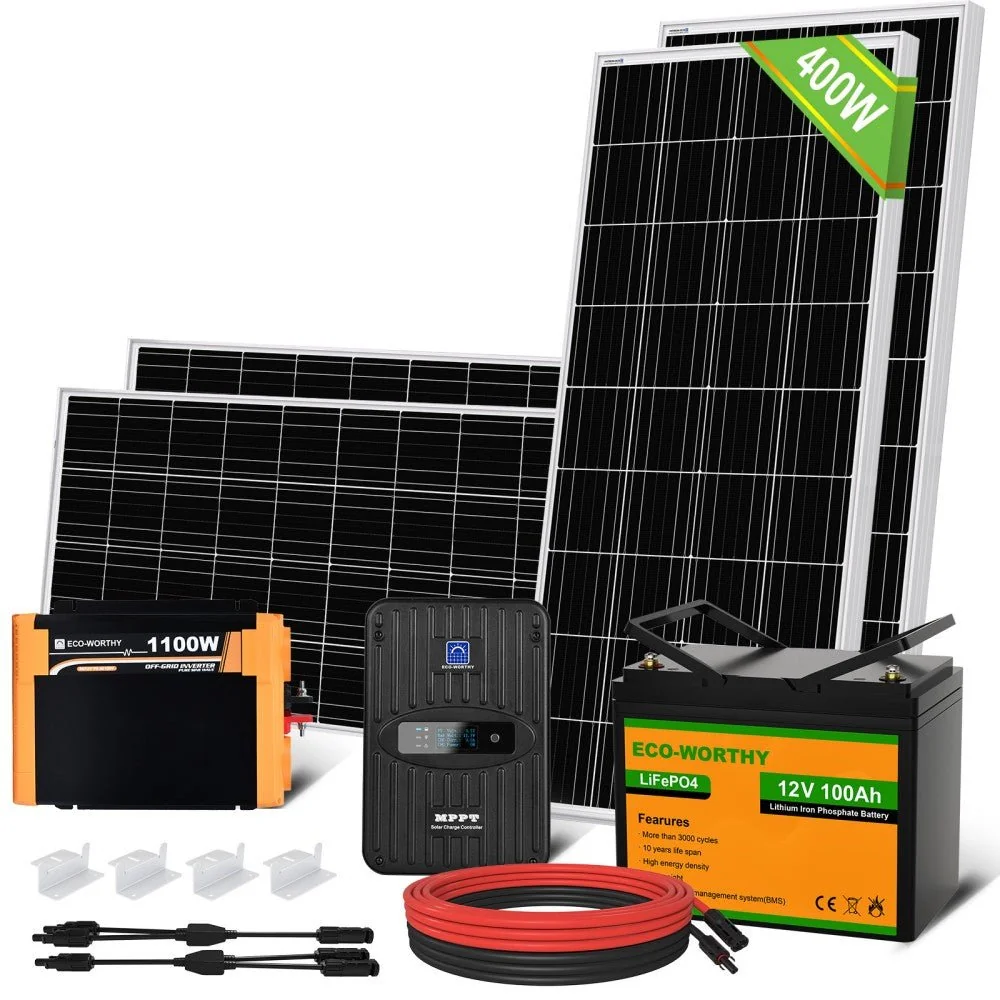
Solar is often the cheapest way to get power into a shed, because running a buried line from the house can cost more than a small kit. For lights, a fan, a radio and phone or tool-battery charging, a 400-watt kit is usually enough. The thing that changes everything is corded power tools: a 15-amp saw needs a bigger inverter and a battery that can deliver high current, not just more panels.
This guide shows how to size a shed system with real numbers, then compares six shed-sized kits from ECO-WORTHY, Rich Solar, Renogy and ShopSolar using each seller's own page. Prices and availability were checked on November 10, 2026. Seller pages stay as the source for those figures.
Short answer
- Cheapest complete kit: ECO-WORTHY 400W kit with 1.2 kWh battery at $799.99 (marked down from $1,099.99). Fine for lights, a fan and charging, but its 1,100W inverter won't run a corded saw.
- Best value if you use power tools: the same ECO-WORTHY kit with 2.4 kWh and a 2,000W inverter at $1,399.99. Two batteries in parallel can deliver the current a 15-amp tool needs.
- Most inverter in a 12V shed kit: Renogy 400W Complete Kit for Workshop/Sheds at $2,499.99 with three 100Ah lithium batteries and a 3,000W inverter, or $1,899.99 with AGM batteries.
- For a shed that's really a workshop: ShopSolar CORE PLUS 800W at $2,549, with double the panels, a 3,000W 24V hybrid inverter that can also charge from a generator, and 5.12 kWh of lithium.
What to use: The cheapest complete kit above — four 100W panels, a 12V 100Ah lithium battery, a 40A MPPT controller and a 1,100W inverter — is also sold on Amazon as the ECO-WORTHY 400W 12V complete kit. The price above is from ECO-WORTHY's own store.
Step 1: List what the shed will run
Daily energy is watts × hours a day. Here's an example workshop shed. The watts come from FirstEnergy's appliance fact sheet and, for the saw, DEWALT's spec page. The hours are our example; use your own.
| Load | Watts | Hours a day (example) | Watt-hours a day |
|---|---|---|---|
| 4 LED bulbs (13W each) | 52 | 3 | 156 |
| Window fan | 70 | 6 | 420 |
| Laptop, 15 inch | 60 | 2 | 120 |
| Circular saw, 15 amp (e.g. DEWALT DWE575) | 1,800 | 0.25 | 450 |
| Clock radio | 5 | 4 | 20 |
| Total | 1,166 Wh (about 1.2 kWh) |
The saw's 1,800W is its label rating, 15 amps × 120 volts, which is the most it should pull while cutting. Notice that 15 minutes of sawing uses about as much energy as the fan does all day. The saw barely matters for panel size, but it decides the inverter and battery, as Step 3 shows.
Skip electric heat. FirstEnergy lists a portable space heater at about 1,320W. Two hours of that is 2.6 kWh, more than double this whole table and more than a 400W kit makes on an average day. Use a propane heater rated for indoor use, or insulate.
Step 2: Check your sun hours
Peak sun hours are the hours per day your panels get the equivalent of full midday sun. We use NASA POWER's 2001–2025 averages for flat ground, which lean conservative because tilted panels collect more in winter. Daily energy from an array is about array kW × sun hours × 0.75, where 0.75 allows 25% for wiring, heat, dirt and charging losses.
| Array | Phoenix, AZ (yearly / Dec) | Denver, CO | Nashville, TN | Columbus, OH |
|---|---|---|---|---|
| 400W (most shed kits) | 1.8 / 0.9 kWh a day | 1.5 / 0.7 | 1.3 / 0.6 | 1.2 / 0.4 |
| 800W (CORE PLUS) | 3.5 / 1.8 | 2.9 / 1.4 | 2.5 / 1.2 | 2.4 / 0.9 |
The yearly sun hours behind those numbers are 5.85 for Phoenix, 4.85 for Denver, 4.23 for Nashville and 3.92 for Columbus. December drops to 3.08, 2.29, 1.92 and 1.48.
Reading that against our 1.2 kWh shed:
- Spring to fall, most of the US: a 400W kit covers it in Phoenix and Denver and comes close in Nashville and Columbus on an average day.
- Winter: 400W makes only a third to three quarters of the load. Either use the shed less, add a generator, or go to 800W.
- Weekend-only shed: the battery refills during the week, so a 400W kit can support far more than its daily number on the days you're actually there.
Rich Solar's own pages give a similar estimate: they say their two 200W panels make about 1.4 kWh a day at 4 peak sun hours.
Step 3: Size the inverter and battery for the biggest tool
This is where shed kits differ most.
Inverter. It has to cover everything that can run at once, plus headroom for motor start-up. Our saw plus lights and fan is about 1,900W. That rules out a 1,100W inverter, makes a 2,000W inverter workable but tight, and fits comfortably on a 3,000W one. If you only have cordless tools, charging their batteries is a small load and any of these inverters will do.
Battery current, not just capacity. On a 12V system, 1,800W at the inverter means roughly 150 amps from the battery (1,800 ÷ 12), before inverter losses. ECO-WORTHY's spec sheet lists its 100Ah battery at a 100A maximum discharge, which works out to about 1,280W at 12.8V. One battery can't feed a 15-amp saw. Two in parallel (the 2.4 kWh option) can share the load. Check the maximum discharge current on whatever battery you buy, and use the cable sizes and fuses the maker specifies.
Capacity. Daily kWh × days of backup ÷ usable fraction. For 1.2 kWh, one day without sun and 80% usable, that's 1.5 kWh. Two days is about 2.9 kWh. Lithium iron phosphate (LiFePO4) batteries are commonly used to 80% or more. ECO-WORTHY lists a charge temperature range of 0–55°C (32–131°F), so in a cold shed, charging stops below freezing unless the battery has a heater. Our LiFePO4 battery guide goes deeper.
Room to grow. A 12V system tops out quickly. Renogy lists the Rover Li 40A controller at 520W of panel input on a 12V battery, and ECO-WORTHY lists its 40A controller at 560W. Both 400W kits are already near that limit, so adding panels later means adding a second controller. The 24V CORE PLUS has more headroom.
Six shed kits compared
| Kit | Price (Nov 10, 2026) | Panels | Battery | Inverter | Controller |
|---|---|---|---|---|---|
| ECO-WORTHY 400W, 1.2 kWh | $799.99 (list $1,099.99) | 4 × 100W | 1 × 12.8V 100Ah LiFePO4 (1.2 kWh) | 1,100W 12V pure sine | 40A MPPT |
| ECO-WORTHY 400W, 2.4 kWh | $1,399.99 | 4 × 100W | 2 × 12.8V 100Ah LiFePO4 (2.4 kWh) | 2,000W 12V pure sine | 40A MPPT |
| Rich Solar 400W Solar Kit with Battery | $1,299.99 | 2 × 200W | ALPHA 1 12.8V 100Ah (1.28 kWh) | None | Bravo 30 30A MPPT |
| Rich Solar Complete 400W Kit | $1,679.99 | 2 × 200W | ALPHA 1 12.8V 100Ah (1.28 kWh) | NOVA PURE 2K, 2,000W (4,000W surge) | Bravo 30 30A MPPT |
| Renogy 400W Complete Kit for Workshop/Sheds | $2,499.99 lithium / $1,899.99 AGM | 4 × 100W | 3 × 12V 100Ah Pro Series lithium or AGM (Renogy lists 3.6 kWh) | 3,000W 12V pure sine | Rover Li 40A MPPT |
| ShopSolar CORE PLUS 800W | $2,549 (5.12 kWh) / $3,089 (7.68 kWh) | 4 × 200W | 2 or 3 × 100Ah 24V LFP | 3,000W 24V hybrid inverter/charger | Built into inverter |
All six showed as available to order on November 10. ShopSolar's CORE PLUS prices were marked down from $3,539 and $4,309, and Renogy's AGM version from $2,089.99. Sale prices change often, so confirm the configuration on the seller's page when you order.
What's in the box
- ECO-WORTHY: four 100W panels, the 40A MPPT controller, a 5-meter (16 ft) panel extension cable, three Y-branch connectors, four Z mounting brackets and a tray cable, plus the inverter and battery in the bundle options. Its page doesn't list fuses or inverter-to-battery cables, so budget for both.
- Rich Solar Complete 400W: two 200W panels, the Bravo 30 controller, the ALPHA 1 battery, the 2,000W inverter, Z brackets, a cable entry housing, a 15A inline panel fuse, 30 ft of panel cable, 10 ft of controller-to-battery cable and 4 ft 2/0 AWG inverter-to-battery cables. The cheaper $1,299.99 kit is the same minus the inverter and its cables, so it only runs 12V DC loads like LED lights and fans unless you add an inverter.
- Renogy Workshop/Sheds: four 100W panels, the Rover 40A controller, three batteries, the 3,000W inverter, Z brackets, Y connectors, 20 ft of panel-to-controller cable, battery interconnect cables, ANL and inline fuse sets, inverter cables and a 500A battery monitor with shunt. It's the most complete parts list of the 12V kits.
- ShopSolar CORE PLUS: four 200W panels, the 3,000W 24V hybrid inverter, the batteries, pre-cut cables, inline fuses and circuit protection, a busbar, and brackets and racking. ShopSolar markets it for sheds, barns, greenhouses and remote structures, and says most buyers do most of the install themselves.
None of these include the shed's AC outlets, breaker box, conduit, permits or labor. Ask your county what it requires, and have an electrician check the AC side.
Which shed kit fits
- Lights, a fan, a radio, charging cordless tool batteries: ECO-WORTHY 400W with 1.2 kWh ($799.99).
- DC-only lighting with room to add an inverter later: Rich Solar 400W Kit with Battery ($1,299.99).
- Occasional corded tools up to about 15 amps: ECO-WORTHY 400W with 2.4 kWh ($1,399.99), or Renogy's Workshop/Sheds kit if you want a 3,000W inverter and a battery monitor.
- A real workshop, year-round use, or a generator for winter: ShopSolar CORE PLUS 800W.
- No permanent install at all: a portable power station plus a folding panel can be carried between the shed and the house. See our portable power station guide.
Mistakes to avoid
- Buying on panel watts alone. For tools, the inverter rating and battery discharge current matter more.
- One 100Ah battery behind a 2,000W inverter. Check that the battery's maximum discharge current can feed the inverter at full load.
- Charging lithium in a freezing shed. Look for a self-heating battery or keep it insulated.
- Space heaters on solar. They use more in two hours than a 400W kit makes in a day.
- Mounting panels in shade. A tree's shadow over part of the roof cuts output sharply. Ground-mount the panels if the roof is shaded.
To run your own numbers, use the off-grid solar calculator. If the shed is turning into a cabin, see Off-Grid Cabin Solar: Kits and Sizing.
Sources
- ECO-WORTHY: 400W 12V (4x100W) Off Grid Solar Kit: prices, package contents, controller, inverter and battery specs. Checked November 10, 2026.
- Rich Solar: Complete 400W Solar Kit with Battery & Inverter and 400W Solar Kit with Battery: prices, kit contents and daily energy estimate. Checked November 10, 2026.
- Renogy: 400W 12V Complete Solar Panel Kit with 3.6kWh Battery (Workshop/Sheds): prices, package contents and controller specs. Checked November 10, 2026.
- ShopSolar: CORE PLUS 800W: prices, included parts and specs. Checked November 10, 2026.
- DEWALT: DWE575 7-1/4 in. Lightweight Circular Saw: 15-amp rating. Checked November 10, 2026.
- FirstEnergy: Understanding Electricity Usage & Costs: approximate appliance watts.
- NASA POWER all-sky surface irradiance, 2001–2025 climatology for state capitals, as used in our off-grid solar calculator (pulled November 3, 2026).