
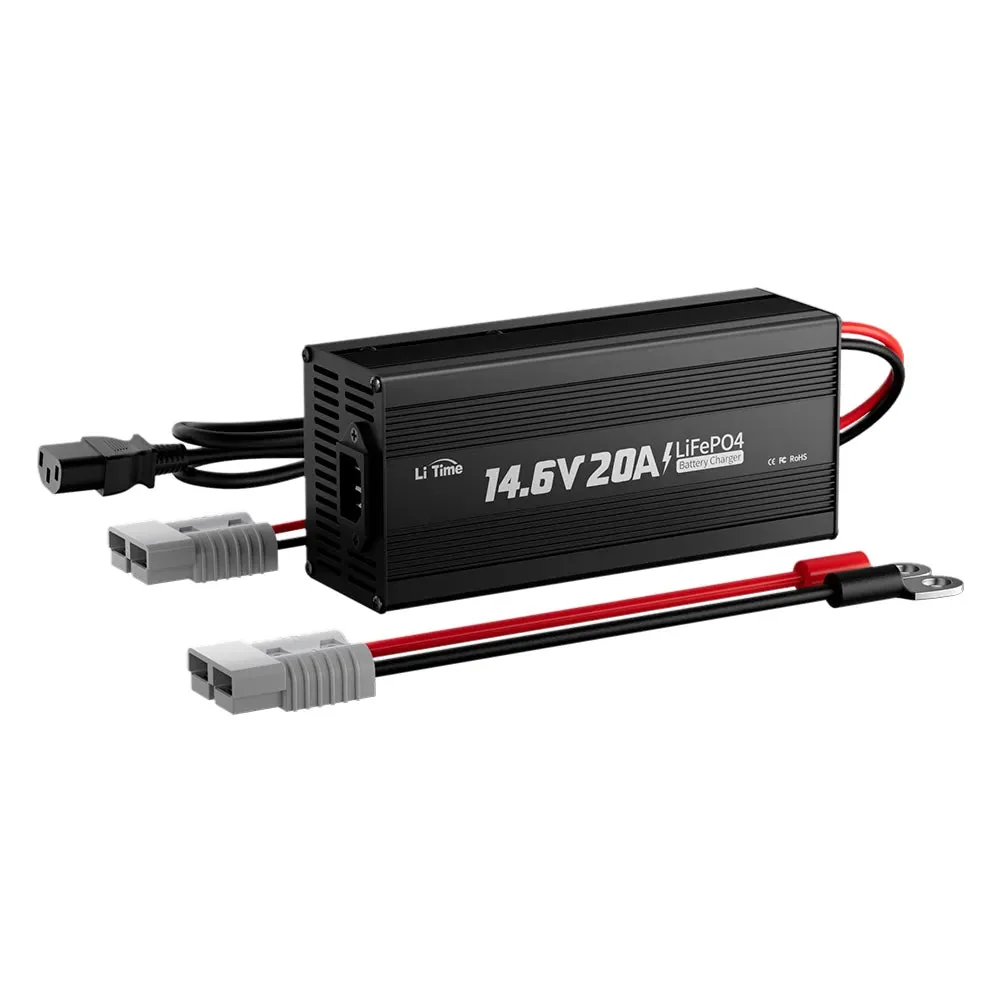
A LiFePO4 battery will happily take a charge from your solar panels most days. But sooner or later you'll want to charge it from something else: a wall outlet in the garage before a trip, a generator during a cloudy week, or your vehicle's alternator on the drive to the cabin. That's what a dedicated LiFePO4 battery charger is for.
The good news: lithium iron phosphate is easy to charge. The bad news: the wrong charger can undercharge it forever, push it too hard, or, if it's an old lead-acid charger with a desulfation or equalize mode, hit it with voltages it was never designed for.
This guide covers what a LiFePO4 charger actually does, how to match voltage and amps to your battery, when you want an AC charger versus a DC-DC charger, and then nine real chargers with prices and specs taken from each seller's own product page. Everything was checked on November 14, 2026. Prices change often, so treat the seller page as the final word.
Short answer
- Cheapest decent 12V LiFePO4 charger: Redodo 14.6V 10A at $59.99, for batteries around 50Ah.
- Best value for a 100Ah battery: LiTime 12V 20A at $109.99, or the Redodo 14.6V 20A at $82.99.
- Best all-rounder if you also own lead-acid batteries: Victron Blue Smart IP65 12/15 at $175.95. It has a dedicated Li-ion (LiFePO4) mode, Bluetooth, no fan and a five-year warranty.
- Big 12V banks (200Ah and up): LiTime 12V 40A at $167.19 or the 60A version at $209.99.
- Charging from a generator: IOTA DLS-55 (12V, 55A) at $262.00 plus the IQ4 LiFePO4 controller at $31.00.
- 48V (51.2V) batteries: LiTime 48V 18A at $155.99.
- Charging while you drive: a DC-DC charger such as the Renogy DCC30S (from $186.99) or Victron Orion XS 12/12-50A ($328.10).
What to use: For most people with a single 12V 100Ah LiFePO4 battery, the LiTime 12V 20A LiFePO4 charger on Amazon is the simple pick: 14.6V output, 20A, 0V activation, and both M8 ring terminals and an Anderson connector. LiTime's own page lists it at $109.99; Amazon's price can differ.
What a LiFePO4 battery charger actually does
A "12V" LiFePO4 battery is four lithium iron phosphate cells in series. Its resting voltage when full sits in the mid-13V range, and it needs a bit more than that to finish charging. A good LiFePO4 charger does three things:
- Pushes constant current (CC) until the battery reaches the target voltage. This is where most of the charging happens, and why LiFePO4 charges so much faster than lead-acid.
- Holds constant voltage (CV) while the current tapers off, then stops or drops to a low holding voltage.
- Wakes up a sleeping battery. If a battery's built-in BMS (battery management system) shut it off after a deep discharge, many plain chargers see "0V" and refuse to start. Most of the lithium chargers below have a BMS activation or 0V recovery feature for exactly this.
What it should not do is follow a lead-acid routine. Lead-acid chargers often add a float stage held for weeks, temperature compensation that raises voltage when it's cold, and sometimes an equalization or desulfation pulse. None of that helps a LiFePO4 battery. Victron's manual for the Blue Smart IP65, for example, notes that temperature compensation is automatically disabled in its Li-ion mode.
Lead-acid charger vs lithium charger: can you use the one you have?
Sometimes. Check three things in your current charger's manual:
- Does it have a lithium or LiFePO4 mode? Many newer multi-chemistry chargers do (the Victron Blue Smart line and NOCO's GENIUS10, listed by NOCO at $99.95, are examples). If yes, use that mode.
- Can it be set to a fixed voltage with no equalize or desulfate step? If you can't turn those off, don't use it on lithium.
- What does your battery maker allow? The battery manual is the final word on charge voltage. The 12V chargers in this guide use either 14.6V (the dedicated LiFePO4 chargers) or 14.2V (Victron's Li-ion mode), so confirm your battery accepts the charger's voltage.
If your charger is an old transformer-style lead-acid unit with no lithium setting, a dedicated LiFePO4 charger from $59.99 is cheap insurance for a battery that cost far more.
How to size a LiFePO4 charger
1. Match the voltage
This is the one you can't get wrong. Pick the charger that matches the battery's nominal voltage:
| Battery (nominal) | Typical LiFePO4 charger output | Examples in this guide |
|---|---|---|
| 12V (12.8V) | 14.6V | Redodo 10A/20A, LiTime 10A/20A/40A/60A, Renogy 20A |
| 24V (25.6V) | 29.2V | Renogy 24V 10A, LiTime 24V 20A |
| 36V (38.4V) | 43.8V | LiTime 36V 15A/25A, Redodo 43.8V 25A |
| 48V (51.2V) | 58.4V | LiTime 48V 10A/18A/30A, Redodo 58.4V 18A |
Note the pattern: the output voltage is 3.65V per cell times the number of cells (4, 8, 12 or 16). A 14.6V charger on a 24V battery won't charge it; a 29.2V charger on a 12V battery would be dangerous.
2. Pick the amps
More amps means faster charging, up to a limit. Victron's Blue Smart manual gives a useful rule of thumb: the maximum charge current for LiFePO4 batteries should not exceed about 0.5C, meaning half the battery's amp-hour rating. Also check your battery's own maximum charge current, which can be lower.
| Battery size | Sensible charger size | Rough time from near-empty* |
|---|---|---|
| 50Ah | 5–10A | 5–10 hours |
| 100Ah | 10–20A (up to 50A max per the 0.5C rule) | 5–10 hours at 10–20A |
| 200Ah | 20–40A | 5–10 hours |
| 300–400Ah | 40–60A | 5–10 hours |
*Simple math: amp-hours ÷ charger amps, plus a little extra for the taper at the end. LiTime's own figure for its 40A charger is a full charge of a 12V 100Ah battery in 2.5 hours and 200Ah in 5 hours.
Going too small is mostly an inconvenience. Going too big for a small battery can stress it, which is why some chargers (like the Victron) have a low-current mode for small batteries.
3. Think about where it lives
- Indoors in a garage or utility room: fan-cooled aluminum chargers like the LiTime 20A/40A/60A are fine. LiTime itself recommends those for RVs, homes, cabins and garages, and suggests its waterproof models for long-term marine use.
- Outdoors, in a boat, or anywhere damp: choose an IP65 or better model, such as the Victron Blue Smart IP65, LiTime 12V 10A IP65 or LiTime 48V 18A IP65.
- Quiet spaces like a van or bedroom closet: fanless chargers (Victron Blue Smart, Renogy 20A AC-to-DC) make no fan noise.
4. Know how much AC power it pulls
A charger putting out 14.6V at 20A is delivering about 290W to the battery, so it draws a bit more than that from the outlet. A 60A model at 14.6V is around 875W of output. That matters if you're running the charger from a small generator or a portable power station. Size the generator with headroom.
AC charger, DC-DC charger or solar: which do you need?
These aren't competitors; many systems use two or three of them.
- Solar charge controller: Charges from panels. If your off-grid system already has one with a lithium profile, that's your daily charger. See our charge controller guide.
- Inverter-charger: Most all-in-one off-grid and hybrid inverters can charge the battery from the grid or a generator, so you may not need a separate AC charger at all. See our off-grid inverter guide.
- Standalone AC charger: For batteries that live outside a full system (trolling motors, a portable battery box, a shed battery), for topping up before storage, or for bulk charging from a generator.
- DC-DC charger: For charging a house battery in a van, truck or RV from the vehicle's alternator. A DC-DC charger limits how much current it draws from the alternator and applies a lithium charge profile to the house battery.
The nine picks compared
| Charger | Battery | Charge current | Waterproof | Cooling | Price (seller, Nov 14, 2026) |
|---|---|---|---|---|---|
| Redodo 14.6V 10A | 12V | 10A | Not stated | Not stated | $59.99 |
| LiTime 12V 10A IP65 | 12V | 10A | IP65 | Fan | $79.99 |
| Redodo 14.6V 20A | 12V | 20A | Not stated | Not stated | $82.99 |
| LiTime 12V 20A | 12V | 20A | No | Fan | $109.99 |
| Renogy 12V 20A AC-to-DC LFP | 12V | 20A | Not stated | Fanless | $151.99 |
| Victron Blue Smart IP65 12/15 | 12V (multi-chemistry) | 15A (4A low mode) | IP65 | Fanless | $175.95 |
| LiTime 12V 40A / 60A | 12V | 40A / 60A | No (indoor use) | Fan | $167.19 / $209.99 |
| IOTA DLS-55 + IQ4 LiFePO4 | 12V | 55A | Not stated | Not stated | $262.00 + $31.00 |
| LiTime 48V 18A | 48V (51.2V) | 18A | IP65 | Fan | $155.99 |
1. Redodo 14.6V 10A: cheapest for small batteries
$59.99 at Redodo. A 14.6V, 10A charger made for 12V (12.8V) LiFePO4 batteries, with a pre-charge, constant-current and constant-voltage routine, BMS activation, an aluminum case, and protection against over-temperature, reverse polarity, short circuit and over-voltage. Redodo gives a two-year warranty. Redodo says it charges a 50Ah battery to 50% in 2.5 hours. A good match for trolling-motor batteries, a small shed battery or a 50Ah portable box.
2. LiTime 12V 10A IP65: small and weatherproof
$79.99 at LiTime. Same 14.6V/10A output class, but IP65-rated for RV, marine and outdoor use. It has M8 terminals plus a 30A Anderson connector, a 100–240V AC input, a fan-cooled aluminum shell and a two-year warranty. Pick this over the Redodo if the charger will live somewhere damp.
3. Redodo 14.6V 20A: budget pick for a 100Ah battery
$82.99 at Redodo. Twice the current of its 10A sibling, with the same three-stage LiFePO4 routine, BMS activation and two-year warranty. Redodo says it takes a 12V 100Ah battery to 50% in 2.5 hours. It's the lowest-cost 20A option we found on a maker's own site.
4. LiTime 12V 20A: best value for most people
$109.99 at LiTime (on Amazon). 14.6V, 20A, 100–240V AC input, with 0V activation to recover deeply discharged batteries. The current version has both an M8 terminal and a 50A Anderson connector, a fan, LED status lights and protection against over-temperature, reverse polarity, short circuit, over-current and over-voltage. Two-year warranty. LiTime's Amazon listing warns it isn't waterproof and isn't meant for marine environments. For a single 100Ah battery in a garage, cabin or RV storage bay, it's the one we'd buy.
5. Renogy 12V 20A AC-to-DC LFP: the quiet one
$151.99 (12V 20A) or $130.99 (24V 10A) at Renogy. Designed for 12V lithium iron phosphate batteries, with lithium activation to exit BMS protection, a three-stage routine (constant current, constant voltage, trickle), and efficiency Renogy lists at up to 92%. The selling point is the fanless, heat-dissipating shell: no fan noise and no worries about mounting angle. It comes with ring-terminal and alligator-clip cables plus a mounting bracket.
6. Victron Blue Smart IP65 12/15: best if you have mixed batteries
$175.95 at Dakota Lithium. Victron's manual lists these specs for the 12/15:
- Li-ion mode: 14.2V absorption, 13.5V storage, four-stage algorithm, no temperature compensation.
- Lead-acid modes: Normal (14.4V) and High (14.7V) with temperature compensation.
- Current: 15A, or 4A in low-current mode for small batteries. Victron rates it for lithium batteries of 30Ah and up at full current (8Ah and up in low mode).
- Built-in Bluetooth through the VictronConnect app, 94% max efficiency, 0.5W standby draw.
- IP65, convection cooled (no fan), rated for -20 to 50°C (-4 to 122°F) with full output up to 30°C (86°F).
- Five-year limited warranty.
It costs more than the dedicated LiFePO4 chargers and charges slower than the 20A models, but it's the one charger here that also handles your truck's AGM battery, has an app, and can sit outdoors. Victron also makes it in 12/10 and 12/25 sizes.
7. LiTime 12V 40A and 60A: for big 12V banks
$167.19 (40A) and $209.99 (60A) at LiTime. Both are 14.6V LiFePO4-only chargers with BMS activation, M8 terminals, Anderson connectors (50A on the 40A model, 120A on the 60A model), mounting holes, a handle and a two-year warranty. Note the 60A lists a 100–120V AC input, while the 40A lists 100–240V. LiTime recommends both for indoor use. Remember the 0.5C rule: a 40A charger suits about 80Ah and up, a 60A about 120Ah and up, and check your battery's own charge limit.
8. IOTA DLS-55 with IQ4 LiFePO4: the generator charger
$262.00 for the IOTA DLS-55 and $31.00 for the IQ4 LiFePO4 Smart Charge Controller at Backwoods Solar. The DLS-55 is a 12V, 55A charger with up to 750W continuous output, and Backwoods describes it as well suited to generator-based charging. On its own it has no dedicated float function; the IQ4 LiFePO4 plug-in gives it a LiFePO4 profile for 4-cell batteries with a BMS, then sits in standby and starts a new bulk charge after 15 days in float. Backwoods notes the DLS tolerates input up to 132VAC, and advises warming the generator up before connecting the charger and disconnecting it before shutdown. If your charger's setpoints were adjusted before, talk to the seller before adding the IQ4.
9. LiTime 48V 18A: for 48V (51.2V) batteries
$155.99 at LiTime. 58.4V/18A output for 48V and 51.2V LiFePO4 batteries, 100–240V AC input, BMS activation, IP65, fan cooling, CE/FCC/RoHS and a two-year warranty. Need more speed? LiTime also lists a 48V 30A model at $209.99, and Redodo sells a 58.4V 18A charger at $149.99. For a big 48V home bank you'll usually charge through the inverter-charger or a generator input instead; these suit golf carts, smaller 48V packs and topping off.
DC-DC chargers for vans, trucks and RVs
If your LiFePO4 house battery rides in a vehicle, a DC-DC charger lets the alternator charge it properly while you drive.
- Renogy DCC30S 12V 30A: $186.99 (charger only) or $214.99 with Bluetooth. It takes both alternator and solar input at the same time, with a built-in MPPT solar controller Renogy rates at up to 99% tracking efficiency and 94% conversion efficiency. A 50A version is $307.99.
- Victron Orion XS 12/12-50A: $328.10 at Backwoods Solar. Charge current is adjustable from 1 to 50A in 0.1A steps, it works with smart alternators, detects when the engine is running, has Bluetooth, is IP65, and is rated for 700W continuous at 14V. Input current limiting helps keep the alternator from overheating.
Smaller Victron Orion-Tr Smart units (18A and 30A isolated, from $143.65 at Backwoods Solar) suit lighter systems.
Safe charging habits for LiFePO4
- Don't charge below freezing unless the battery is heated. Victron's charger manual warns: do not charge Li-ion batteries if the battery temperature is below 0°C (32°F). Some LiFePO4 batteries have low-temperature charge protection in the BMS; check your battery's manual rather than assuming it does.
- Use the right cable and fuse. Use the cables supplied with the charger, and keep a fuse on the battery's positive line as close to the battery as practical.
- Connect in the right order. Renogy's instructions for its 20A charger: connect negative to negative, then positive to positive, then plug in the AC cord.
- Follow your battery maker's storage advice. Chargers differ in what they do after a full charge: Victron's Li-ion mode drops to a 13.5V storage voltage, while the IOTA IQ4 waits in float and re-charges after 15 days.
- Never use desulfation or equalize modes on lithium.
Which one should you buy?
- One 12V battery under about 60Ah: Redodo 10A ($59.99) or LiTime 10A IP65 ($79.99) if it's outdoors.
- One 12V 100Ah battery: LiTime 20A ($109.99) or Redodo 20A ($82.99); Renogy 20A if you want it silent.
- Mixed lead-acid and lithium, or you want an app: Victron Blue Smart IP65 12/15.
- 200–400Ah of 12V lithium: LiTime 40A or 60A.
- Generator charging at a cabin: IOTA DLS-55 with the IQ4 LiFePO4 plug.
- 48V battery: LiTime 48V 18A.
- Charging from a vehicle: Renogy DCC30S or Victron Orion XS.
Still choosing the battery itself? Start with our LiFePO4 battery guide, then use the battery bank calculator to size the bank and the off-grid solar calculator to size the panels that will do most of the daily charging.
Sources
- Victron Energy, Blue Smart IP65 Charger manual, 120V (technical specifications, LiFePO4 0.5C guidance, below-0°C charging warning, warranty), checked November 14, 2026.
- LiTime product pages (prices and specs checked November 14, 2026): 12V 10A IP65, 12V 20A, 12V 40A, 12V 60A, 48V 18A, 48V 30A.
- Redodo product pages (checked November 14, 2026): 14.6V 10A, 14.6V 20A, 58.4V 18A.
- Renogy product pages (checked November 14, 2026): 12V 20A/24V 10A AC-to-DC LFP charger, DCC30S, DCC50S.
- Dakota Lithium, Victron Blue Smart IP65 Charger 12V/15A (price checked November 14, 2026).
- Backwoods Solar product pages (checked November 14, 2026): IOTA DLS-55, IOTA IQ4 LiFePO4, Victron Orion XS 12/12-50A.
- NOCO, GENIUS10 (price checked November 14, 2026).