
Most RVs leave the factory with one or two lead-acid "house" batteries in a tray near the tongue or under a step. They are heavy, and in practice you should only use about half of their rated capacity if you want them to last. Swap them for an RV lithium battery (almost always LiFePO4, lithium iron phosphate) and you get roughly twice the usable energy in a lighter box that doesn't need watering.
The swap is easy. Picking the right battery takes a bit more care: it has to fit your tray, survive your camping season, and match your converter, inverter and alternator.
This guide covers what to check before you buy, then compares nine real 12V RV lithium batteries using prices and specs from each maker's own product page. Everything was checked on November 15, 2026. Prices change often (several of these were on sale that day), so treat the maker's page as the final word.
Short answer
- Best value Group 24 drop-in: LiTime 12V 100Ah Group 24 at $278.99. 21 lbs, 100A continuous, five-year warranty.
- Cheapest 100Ah in this guide: Redodo 12V 100Ah Group 24 at $249.99.
- Best budget pick for cold-weather camping: LiTime LiHeat 12V 100Ah Group 24 at $368.99, with self-heating, Bluetooth and a low-temperature charge cutoff.
- Smallest heated 100Ah: Renogy Reserve Mini Smart 12V 100Ah at $399.99. 9.0 x 5.4 x 8.4 in, with heating pads Renogy rates down to -22°F.
- Toughest case and longest Renogy warranty: Renogy Pro 12V 100Ah Smart at $629.99. IP67, self-heating, seven-year warranty.
- Premium, assembled in the USA: Battle Born BB10012 at $799.00, or the heated BB10012H kit at $999.00. Ten-year warranty.
- Most amp-hours per dollar: Redodo 12V 300Ah at $599.99. It's big (Group 6D box size, 59.6 lbs).
- 300Ah in a smaller box: Renogy Core Mini 12V 300Ah at $879.99, with a 200A BMS and low-temperature charge cutoff.
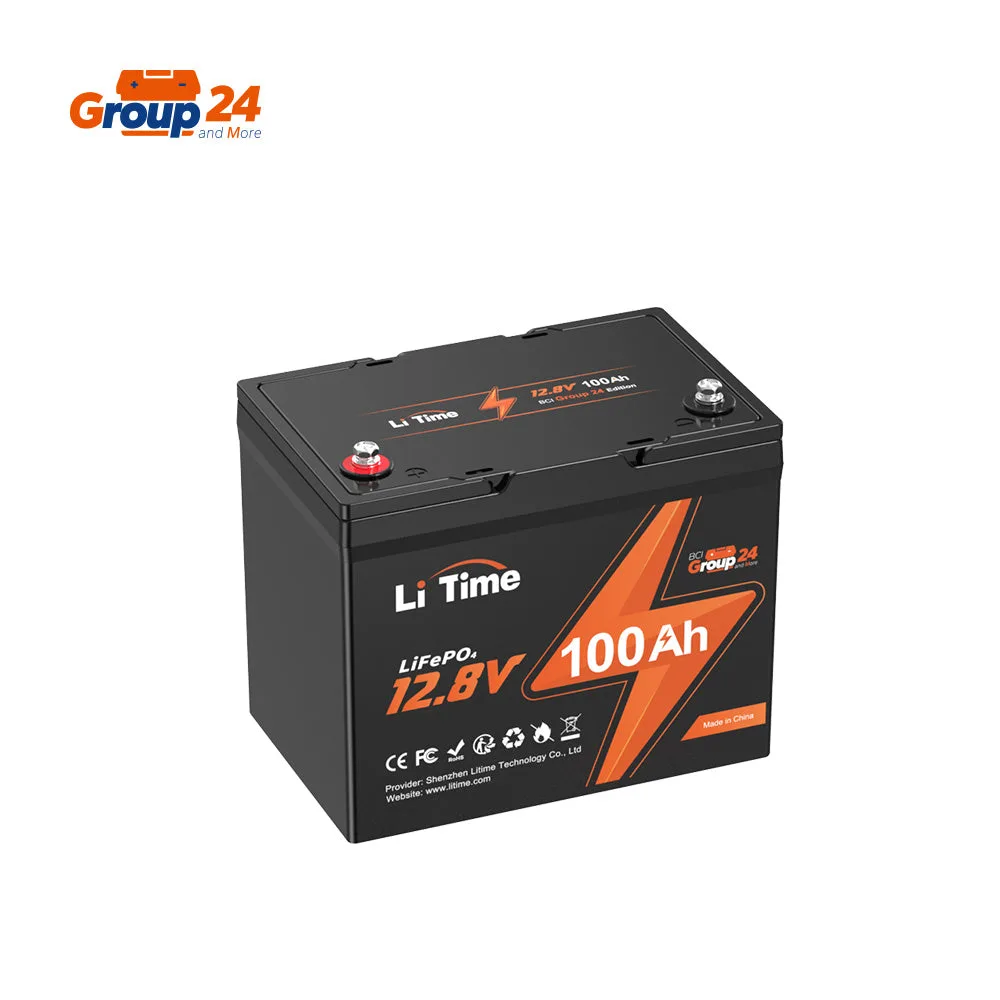
What to use: If your RV has a standard Group 24 tray and you camp above freezing, the LiTime 12V 100Ah Group 24 battery on Amazon is the simple pick: it drops into a Group 24 tray, has a 100A BMS, and LiTime's own page lists it at $278.99. Amazon's price can differ.
What makes an "RV" lithium battery
Every battery in this guide is a 12V (12.8V nominal) LiFePO4 deep-cycle battery. There's nothing magic about the word "RV" on the label. What matters for RV use is:
- It fits your tray. RV battery boxes are sized for lead-acid group sizes, most often Group 24, 27 or 31. Lithium batteries come in the same footprints, so you can usually drop one straight in.
- It's a house battery, not a starter. Every maker here says the same thing on its product page: these are deep-cycle batteries, not for starting engines. In a motorhome, the chassis starting battery stays lead-acid (or a dedicated starting battery); only the house bank goes lithium.
- It can handle your inverter. A 100A BMS means about 1,280W of continuous output from one battery. If you run a 2,000W inverter for a microwave or hair dryer, you need either two 100Ah batteries in parallel or a single battery with a 200A BMS.
- It survives your seasons. LiFePO4 can usually discharge below freezing but must not be charged below about 32°F unless it has heating. RVers who camp in shoulder seasons or winter should pay attention to this one.
Lithium vs the lead-acid battery your RV came with
The practical difference is usable energy. Battle Born, for example, rates its 100Ah lithium battery as equal to about 200Ah of lead-acid ("Ah PbEq 200Ah" on its spec sheet) because you can use 100% of the lithium battery's capacity. LiTime makes a similar point on its Group 24 page: its 100Ah battery stores 1,280Wh, while it rates a 70Ah Group 24 AGM at just 504Wh of usable energy at 60% depth of discharge.
Weight drops too. The 100Ah Group 24 batteries below weigh about 21 to 23 lbs. That matters on a travel trailer, where batteries usually sit on the tongue.
The catch is price up front, and the fact that your RV's charging gear has to be set up for lithium.
Before you buy: four checks
1. Measure your battery tray
Write down the inside length, width and height of your battery box or tray, and check whether a lid has to close over the terminals. Then compare it with the dimensions below. Group 24 lithium batteries (about 10.2 x 6.6 x 8.3 in) fit almost anywhere. Battle Born's 12.76 x 6.86 x 8.95 in battery is sized for Group 27 and Group 31 trays. The 300Ah batteries need much more room.
2. Check your converter/charger
Your RV's converter charges the house battery from shore power or a generator. The batteries in this guide list charge voltages between 14.2V and 14.6V:
- Battle Born: 14.2–14.6V charge, 13.4–13.8V float.
- LiTime: 14.4V ± 0.2V.
- Redodo: 14.6V (100Ah); 14.4V ± 0.2V (300Ah).
- Renogy Reserve Mini: 14.4V.
Look up your converter's model number. If it has a lithium or LiFePO4 mode, use it. If it's an older lead-acid-only unit that can't reach the battery's charge voltage, it may never fully charge your new battery, and a lithium-compatible converter or a separate LiFePO4 charger is the fix. Our guide to LiFePO4 battery chargers covers sizing and voltage.
3. Plan alternator charging
If you charge from your tow vehicle or motorhome engine while driving, put a DC-DC charger between the alternator and the lithium bank. A lithium battery can draw far more current than a lead-acid battery, and a DC-DC charger limits it to a set number of amps and applies the right charge profile. The charger guide has real DC-DC picks.
4. Decide whether you need heating
Look at each battery's charge temperature range, not its discharge range:
- Non-heated batteries in this guide list charging from 32°F (LiTime Group 24, Redodo Group 24 and 300Ah, Renogy Core Mini 300Ah).
- Heated versions list charging well below freezing: LiTime LiHeat from -4°F, Renogy Pro from -4°F, and the Renogy Reserve Mini from -22°F.
If your RV sits in a heated garage or you only camp in summer, skip the heater and save money. If you dry-camp in the mountains in October, the heated versions are worth it, especially if your solar starts charging at sunrise when the battery is coldest.
Nine RV lithium batteries compared
All prices and specs are from each maker's own product page, checked November 15, 2026. "Per Ah" is the price divided by amp-hours, to compare value. "Not listed" means the spec wasn't on the product page.
| Battery | Price | Per Ah | Weight | Size (L x W x H) | Continuous current | Charge temp range | Heating | Warranty |
|---|---|---|---|---|---|---|---|---|
| Redodo 12V 100Ah Group 24 | $249.99 | $2.50 | 21 lbs | 10.24 x 6.61 x 8.30 in | 100A | 32–122°F | No | 5 years |
| LiTime 12V 100Ah Group 24 | $278.99 | $2.79 | 21 lbs | 10.23 x 6.61 x 8.22 in | 100A | 32–122°F | No | 5 years |
| LiTime LiHeat 12V 100Ah Group 24 | $368.99 | $3.69 | 22.71 lbs | 10.24 x 6.61 x 8.27 in | 100A | -4–122°F | Yes | 5 years |
| Renogy Reserve Mini Smart 12V 100Ah | $399.99 | $4.00 | 21.6 lbs | 9.0 x 5.4 x 8.4 in | 100A | -22–131°F | Yes | 5 years |
| Renogy Pro 12V 100Ah Smart | $629.99 | $6.30 | 26.9 lbs | 10.6 x 7.6 x 8.1 in | 100A | -4–131°F | Yes | 7 years |
| Battle Born BB10012 | $799.00 | $7.99 | 31 lbs | 12.76 x 6.86 x 8.95 in | Not listed | Not listed | No | 10 years |
| Battle Born BB10012H (heated kit) | $999.00 | $9.99 | 31 lbs | 12.76 x 6.86 x 8.95 in | Not listed | Not listed | Yes | 10 years |
| Redodo 12V 300Ah | $599.99 | $2.00 | 59.6 lbs | 20.55 x 9.33 x 8.58 in | 200A | 32–122°F | No | 5 years |
| Renogy Core Mini 12V 300Ah | $879.99 | $2.93 | 55.1 lbs | 15.12 x 7.64 x 9.96 in | 200A | 32–140°F | No | 5 years (prorated) |
The picks, one by one
Best value Group 24: LiTime 12V 100Ah Group 24 ($278.99)
LiTime built this one around the BCI Group 24 footprint, the most common RV house battery size, and its page says it's compatible with all types of RVs. Spec sheet highlights:
- 1,280Wh, 100A continuous charge and discharge, 280A for 5 seconds and 400A for 1 second.
- 4,000 cycles at 100% depth of discharge (6,000 at 80%, 15,000 at 60%).
- 21 lbs, 10.23 x 6.61 x 8.22 in, M8 bolt terminals, IP65 (per the product description).
- Charge temperature 32°F to 122°F. No low-temperature protection is listed for this version, so don't let it charge below freezing.
- Five-year warranty. Up to four in series and four in parallel (4P4S).
Watch out for: no Bluetooth and no heating on this model. LiTime sells a Bluetooth Group 24 and the LiHeat version below if you want those.
Cheapest 100Ah: Redodo 12V 100Ah Group 24 ($249.99)
Redodo's Group 24 is the lowest-priced 100Ah battery in this guide and nearly identical on paper to the LiTime: 1,280Wh, 100A BMS, 400A surge for one second, 21 lbs, 10.24 x 6.61 x 8.30 in. Redodo lists 4,000 cycles at 100% depth of discharge, a 14.6V charge voltage and a recommended 20A charge current.
Watch out for: Redodo's own spec table says "NO" to low-temperature protection on this model, and the charge range starts at 32°F. Redodo also says it's not suitable for high-power uses such as water pumps or electric jacks. Fine for warm-weather camping with a careful charging setup; pick a heated battery otherwise.
Best budget cold-weather pick: LiTime LiHeat 12V 100Ah Group 24 ($368.99)
This is the LiTime Group 24 with two heating pads, Bluetooth and a smarter BMS, for about $90 more. The specs that matter for winter:
- Low-temperature protection: charging and discharging shut off below 32°F, and charging resumes at 41°F or above.
- Heating works from -4°F to 41°F. LiTime lists about 70–90 minutes to heat from 14°F and 100–150 minutes from -4°F.
- Heating needs a charge current of at least 10A, and LiTime offers two heating modes in its app.
- 500A peak for 1 second, 22.71 lbs, same Group 24 footprint.
Watch out for: LiTime says that on first use, or after you switch the battery off by hand, you need to connect a charger to turn it back on.
Smallest heated 100Ah: Renogy Reserve Mini Smart 12V 100Ah ($399.99)
At 9.0 x 5.4 x 8.4 in (including terminals), this is the most compact 100Ah battery in this guide, handy for cramped trays or for fitting two where one big battery used to go. Renogy's DuoHeat system uses two 100W heating pads, and Renogy lists heating from 14°F to 32°F in about 20 minutes, from -4°F in about 40 minutes and from -22°F in about 60 minutes.
Other specs: 100A continuous (about 1,280W), 500A peak for 1 second, a recommended 50A charge current, more than 6,000 cycles at 80% depth of discharge, Bluetooth, IP65, a V0 flame-retardant ABS+PC case, 21.6 lbs and a five-year warranty. Renogy says self-heating starts automatically below 41°F once a stable charge is detected.
Toughest case: Renogy Pro 12V 100Ah Smart ($629.99)
The Pro costs more, and you get a sturdier battery for it: an IP67 rating (Renogy's highest here), a UL94 V-0 fire-resistant casing, mounting holes and brackets, Bluetooth with over-the-air updates, and a seven-year warranty. Self-heating kicks in when the charge current is above 4A and the battery is below 41°F, so it can charge from -4°F.
Specs: 100A continuous charge and discharge, 245A peak for 30 seconds, 5,000 cycles at 80% depth of discharge, 10.6 x 7.6 x 8.1 in, 26.9 lbs. Renogy also lists a bundle with mounting brackets at $579.99 on the same page.
Watch out for: at $6.30 per Ah, you're paying a lot for the ruggedness. It's a good fit for an overland rig or toy hauler that takes a beating; most travel trailers don't need it. Renogy also asks for 1.97–3.94 in of clearance above the battery and at least 7.87 in on the busbar side.
Premium, US-assembled: Battle Born BB10012 ($799.00) and heated BB10012H ($999.00)
Battle Born is the long-time RV favorite, and its page explains why buyers pay double: the batteries are engineered, assembled and tested in Reno, Nevada; use cylindrical LiFePO4 cells recognized to UL 1642; and carry a 10-year warranty, the longest in this guide. Specs from the page:
- 100Ah, rated as equivalent to 200Ah of lead-acid, 100% usable depth of discharge.
- 3,000–5,000 cycles, 2–3% self-discharge per month.
- Charge 14.2–14.6V, float 13.4–13.8V, up to 48V in series.
- 12.76 x 6.86 x 8.95 in (Group 27/31), 31 lbs.
The heated BB10012H uses an internal heating system that Battle Born says is self-powered and warms the cells to a safe charging range when temperatures approach freezing. If you're installing more than one heated battery, Battle Born sells a heat-enable cable kit.
Watch out for: it's the heaviest 100Ah in this guide and the most expensive per amp-hour. The product page didn't list continuous current or a charge temperature range, so check the BB10012 manual (linked on the page) before you size an inverter around it.
Most Ah per dollar: Redodo 12V 300Ah ($599.99)
If you have the space, one 300Ah battery replaces three 100Ah batteries and the wiring between them. At $2.00 per Ah it's the best value here. Redodo lists 3,840Wh, a 200A BMS (2,560W continuous), a recommended 60A charge current, 4,000–15,000 cycles, IP65 and a five-year warranty.
Watch out for: it's 20.55 x 9.33 x 8.58 in and 59.6 lbs, built in a Group 6D-size case. That will not fit a typical tongue tray. Charge range starts at 32°F with no heater.
300Ah in a smaller box: Renogy Core Mini 12V 300Ah ($879.99)
Renogy squeezes 300Ah into 15.12 x 7.64 x 9.96 in and 55.1 lbs, much shorter than the Redodo. It has a 200A continuous discharge rating, 150A maximum charge current, a 380A peak for 10 seconds, 5,000 cycles at 80% depth of discharge, IP65 and a low-temperature charge cutoff (charging from 32°F to 140°F). Warranty is five years, prorated.
This is a strong choice for a fifth wheel or Class A with a bigger battery compartment and a 2,000W inverter.
How much RV battery do you need?
Add up what you'll run in a day, in watt-hours (watts x hours). An example only, not a measured load:
| Example load | Watts | Hours per day | Wh per day |
|---|---|---|---|
| 12V fridge (average draw) | 50 | 24 | 1,200 |
| LED lights | 30 | 5 | 150 |
| Water pump and fans | 60 | 2 | 120 |
| Phones and laptop | 60 | 3 | 180 |
| Total | 1,650 |
A 100Ah LiFePO4 battery stores 1,280Wh, so this example needs at least two 100Ah batteries (2,560Wh) for one day with some margin, or a single 300Ah battery (3,840Wh) for about two days without charging. Add a buffer for inverter losses if you run AC loads. Our battery bank calculator does this math for you, and the off-grid solar calculator sizes the panels to refill it.
Rule of thumb for current: each 100A BMS supports about 1,280W. Two identical 100Ah batteries in parallel share the load, so they can feed a bigger inverter. See our guide to off-grid and hybrid inverters for inverter sizing.
Installation tips
- Don't mix old and new. Replace every lead-acid house battery at once, and don't wire lithium in parallel with lead-acid.
- Match batteries in a bank. Use the same model and capacity when you put batteries in parallel or series, and charge each one fully before connecting them.
- Add a fuse and a battery monitor. A fuse close to the positive terminal protects the wiring. A shunt-based monitor (or the battery's Bluetooth app) tells you what's really left.
- Update your solar controller. Set your charge controller to its lithium or LiFePO4 profile. See best solar charge controllers.
- Storage. Lithium self-discharges slowly (Battle Born lists 2–3% per month), but small parasitic loads in an RV can still drain it over a winter. Use the battery disconnect switch when the RV is parked.
Which one fits your RV
- Weekend camper, summer only, Group 24 tray: LiTime 12V 100Ah Group 24 or Redodo 12V 100Ah Group 24.
- Shoulder-season or winter camping: LiTime LiHeat, Renogy Reserve Mini Smart, or Renogy Pro.
- Tight battery box: Renogy Reserve Mini Smart.
- Want the longest warranty and US assembly: Battle Born BB10012 or BB10012H.
- Big boondocking setup with a 2,000W inverter: Renogy Core Mini 300Ah (compact) or Redodo 300Ah (cheapest per Ah), or two 100Ah batteries in parallel.
For a wider look at LiFePO4 batteries for cabins and homes, including 48V options, see best LiFePO4 batteries for off-grid solar. If you'd rather not touch your RV's wiring at all, a portable power station is the plug-and-play alternative.
Sources
- LiTime product pages (prices and specs checked November 15, 2026): 12V 100Ah Group 24, LiHeat 12V 100Ah Group 24 self-heating.
- Redodo product pages (checked November 15, 2026): 12V 100Ah Group 24, 12V 300Ah.
- Renogy product pages (checked November 15, 2026): Reserve Mini Smart 12V 100Ah, Pro 12V 100Ah Smart, Core Mini 12V 300Ah.
- Battle Born Batteries product pages (checked November 15, 2026): BB10012 100Ah 12V, BB10012H heated kit.
- Amazon, LiTime 12V 100Ah Group 24 listing (product match checked November 15, 2026).